
Table of Contents
Drivers who look into how to become an owner operator usually want to keep more of the revenue their driving already produces. The move itself is mostly paperwork, financing and operating decisions. The driving is the part a company driver already knows.
Becoming an owner operator means making 3 linked choices: which truck to run, which business setup to run it under, and how to find loads. Each choice changes the others. A lease purchase truck limits where your loads come from. Your own authority adds a freight-finding problem that is hardest in the first months, while brokers are still screening you out. A mismatched combination can end a new operation inside its first year.
AFT Dispatch dispatched more than 75,000 loads for owner operators and small carriers, and the first months of a new operation were where most of the trouble showed up. This guide walks through the 3 common paths step by step, what each one costs, and how the pieces fit once the truck is yours to run.
The Short Version
To become an owner operator you need a Class A CDL, enough recent over-the-road experience for an insurer to write you a policy, a truck to run, and a legal way to haul freight. Most drivers take 1 of 3 paths:
- Lease purchase from a motor carrier: the fastest start and the lowest upfront cost, with the highest ongoing cost.
- Owner operator leased to a carrier: you own the truck and run under the carrier’s authority and insurance.
- Owner operator with your own authority: you own the truck, hold your own operating authority and find your own loads.
The costs and the income differ by path. The rest of this article explains how each one works once you are running.
Running your numbers is one side of the business. Getting paid is another. My free 16-video series breaks down what factoring really costs:
Why Drivers Become Owner Operators
A company driver is paid wages, usually by the mile, plus accessorial pay for detention, layovers and extra stops. The ATA’s 2026 Driver Compensation Study put median annual pay for irregular-route truckload company drivers at $73,639 for 2025.
An owner operator is paid for the freight, and the truck’s costs come out of that money. The same study found that leased-on independent contractors at truckload carriers had median compensation of more than $170,000 in 2025. That figure is what carriers paid them before the owner’s truck payment, fuel, insurance, maintenance and other costs. It is revenue to a small business. Most of it goes back out to keep the truck running, and the owner’s pay is what is left.
The take-home side is covered in the income section below, and it often lands near a company driver’s pay. What an owner operator gets for the extra risk is control. You choose the loads, or the carrier you lease to, and you decide how the truck is run and maintained.
Operational reality: Many drivers expect owner operator income to double their company pay. The gross is larger, and the costs of running the truck come out of it before the owner is paid. In the first year, startup costs come out of it too.
CDL and Experience Requirements
CDL Class A
Every owner operator path requires a Class A CDL with the endorsements your freight needs. A private CDL school charges tuition, and some carriers cover the training in exchange for a commitment to drive for them. Most owner operators come from the company driver side and already hold the license.
Endorsements matter more than most new owner operators expect. Hazmat opens additional freight, especially in dedicated and tanker work. A TWIC card opens port loads. Doubles and triples open LTL relay work. None is required to start, and each one widens the loads you can take.
Experience Requirements
Insurance companies set the real experience floor, and motor carriers and lease programs work within it. A commercial trucking insurer looks at how much recent over-the-road experience you have before it writes a policy. A driver with too little either gets turned down or gets quoted a premium the business can’t carry. Lease purchase programs often accept less experience, because the carrier carries the insurance. Own-authority owner operators face the strictest standard, since the policy is in their own name.
A CDL takes weeks to earn. The experience an insurer wants takes longer, and it is the constraint most new drivers don’t plan for. Before you price a truck, ask an insurance agent who writes new authorities what experience they need to see and how it changes the premium.
The 3 Paths to Owner Operator
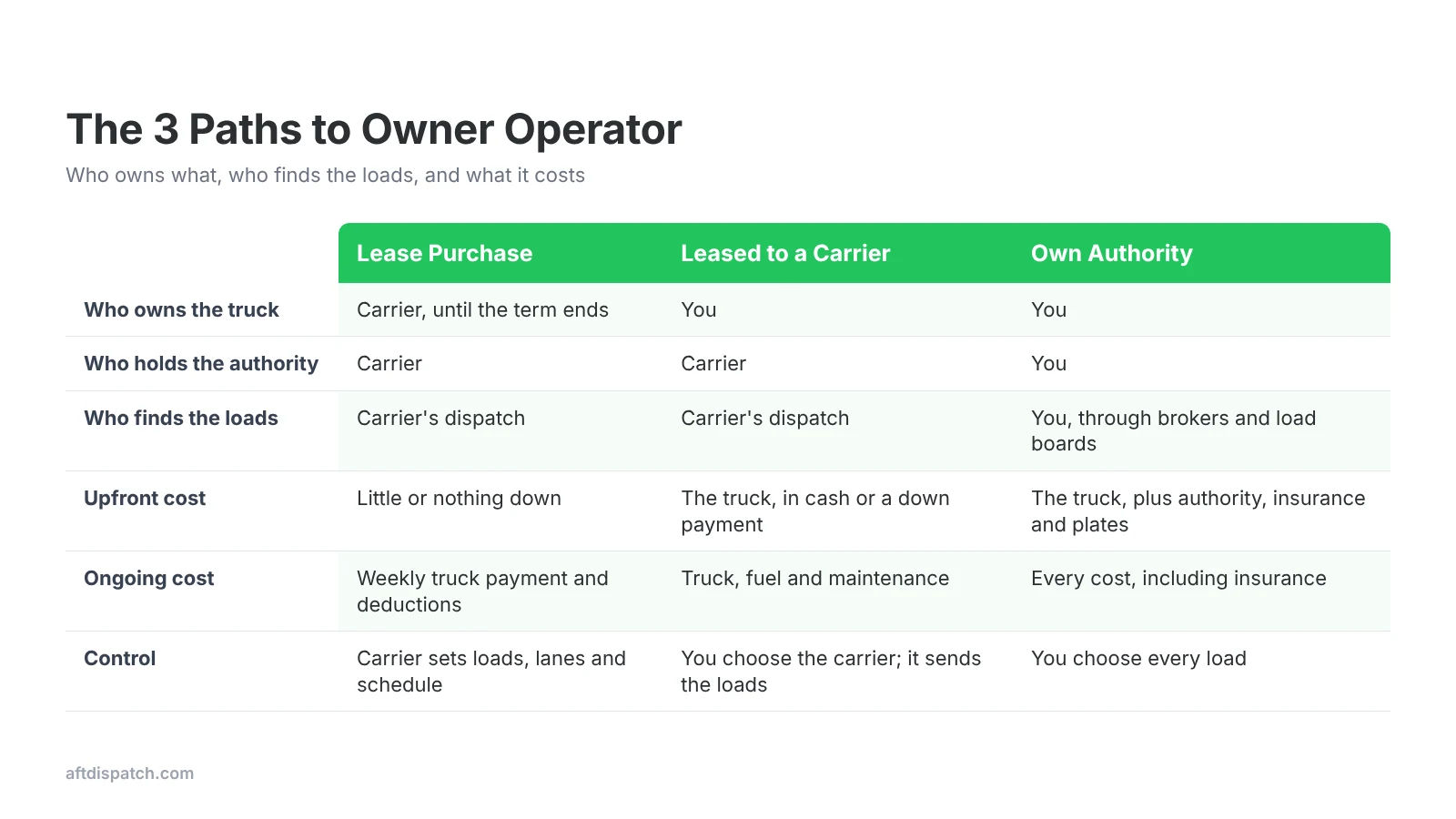
The 3 common paths differ in who owns the truck, who holds the operating authority and who finds the loads. Each combination changes the economics.
Path 1: Lease Purchase
A lease purchase is a contract with a motor carrier. The driver leases a truck from the carrier with the option to own it at the end of a multi-year term. The driver hauls only for that carrier, the carrier dispatches the loads, and the truck payment comes out of the weekly settlement.
Lease purchase is the fastest path. A driver who meets the carrier’s experience requirement can often be in a truck soon after signing, with little or no money down. The carrier handles insurance, plates, fuel cards and dispatch, and the driver hauls and waits for settlement.
The cost is steep. Over the full term, the weekly truck payments often add up to more than the truck is worth. Insurance, maintenance escrow and ELD fees come out of the settlement too. When loads slow down, the truck payment keeps coming out of a smaller check.
Operational reality: Lease purchase programs fit drivers who would otherwise stay in a company truck and want a path to ownership without saving cash first. A driver who wants independence gets little of it here, since the carrier controls the loads, the lanes and the schedule.
Path 2: Owner Operator Leased to a Carrier
This is the middle path. The driver owns the truck (bought with cash, financed, or paid off from an earlier lease) and signs a lease agreement with 1 motor carrier. The carrier runs the loads under its authority and insurance. The truck carries the carrier’s name and number on the doors, and the carrier’s dispatch sends the loads.
Pay usually comes 1 of 2 ways: a percentage of linehaul revenue, or a flat rate per mile paid out of carrier revenue. Fuel discounts, insurance, plates and IFTA filings are usually handled by the carrier and deducted from settlements.
For many owner operators, this path balances ownership with a lighter workload. The driver owns the asset and keeps most of the revenue, and the carrier handles finding loads, FMCSA filings, insurance and compliance. In exchange, the carrier decides which loads come to the truck.
Path 3: Owner Operator with Your Own Authority
This is the full business. The driver owns the truck, holds a USDOT number and operating authority, carries insurance in the business’s name, signs broker contracts and finds loads. It is what most people picture when they think of an owner operator.
Every dollar of linehaul revenue belongs to the business. There is no carrier percentage, no required fuel network and no assigned lane. Everything the carrier used to handle moves onto the owner: insurance, compliance, broker setup, invoicing, and the cash gap that comes with 30 to 45 day broker payment terms.
New authorities also start at a disadvantage with brokers. Many freight brokers won’t book a carrier until its authority has some age on it. The load-finding section below covers how that screening works.
Separate from this, if you factor your invoices or you’re about to, my free 16-video series walks through the real costs and the traps:
What It Actually Costs to Become an Owner Operator
Owner operator startup costs depend on the path. The table lists the line items, with dollar figures only where they are verified.
| Expense | Lease purchase path | Own-authority path |
|---|---|---|
| Truck | Little or nothing down in many programs; payment deducted from weekly settlements | A down payment on a used truck, or financing for most of the price |
| FMCSA operating authority | Covered by the motor carrier | $300 per authority type, paid to FMCSA |
| BOC-3 process agent filing | Covered by the motor carrier | Usually a small one-time fee |
| Insurance | Carrier-provided; deducted from settlements | Often $20,000 or more a year for a new authority |
| LLC or other business setup | Optional | State filing fee, set by your state |
| UCR | Covered by the carrier | $46 for 2026 and $55 for 2027 (0 to 2 vehicles) |
| IRP apportioned plates | Covered by the carrier | About $1,500 to $3,000 a year per truck |
| Form 2290 heavy vehicle use tax | Depends on the program’s terms | Up to $550 a year for a truck over 75,000 lbs |
| Working capital | A cushion for personal bills while settlements start | Enough to cover fuel, repairs and the weeks before broker payments arrive |
The table has no total row. The truck, the down payment and the working capital vary too much by operator to add up to 1 honest number. The line items with verified figures are the authority fee, UCR, IRP, the 2290 and insurance, and insurance is the largest of them by far.
A driver who finances most of a used truck pays less up front and carries a larger monthly payment for years. That payment is due every month whether the truck runs or not.
Working capital is the line new owner operators most often underestimate. The first weeks bring in little or no cash. The truck still needs fuel, and diesel hit a record above $6.50 a gallon in September 2026. The insurance premium still has to be paid, and so do personal bills. The first-year operations that fail usually run out of cash first.
Before you buy, work out what the truck will cost you to run. The guide to your true cost per mile builds the number line by line, from the truck payment through fuel and maintenance.
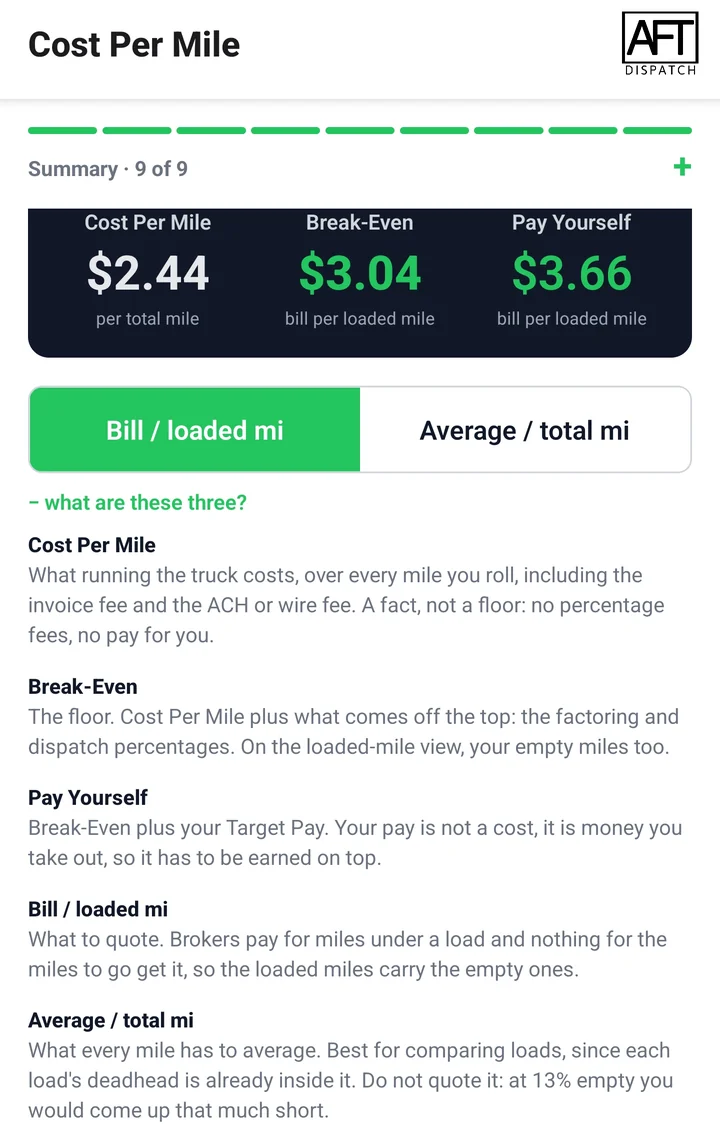
The Summary screen in Trucking Super Calc shows your cost per mile, break-even rate and pay-yourself rate from the costs you enter.
Setting Up the Business
This section applies only to the own-authority path. Lease purchase drivers and carrier-leased owner operators skip almost all of it, because the carrier handles it.
Business Structure
Most owner operators form an LLC before applying for authority. An LLC separates personal assets from business liability, makes tax filing simpler once revenue is steady, and is required by some lenders and insurers. The filing fee is set by your state. The choice between an LLC, a sole proprietorship and an S corporation affects taxes as well as liability. Settle it with an accountant before the authority application goes in, since the application carries the business’s legal name.
DOT and MC Numbers
FMCSA moved carrier registration to its Motus system in 2026, replacing the Unified Registration System. A new carrier goes through it in this order:
- Create an account at motus.dot.gov.
- Verify your identity through Login.gov.
- Apply for a USDOT number and operating authority, and pay FMCSA $300 for each type of authority you apply for.
- FMCSA publishes the application in its Register. From that date, anyone may file a protest within 10 days (49 CFR 365.203T).
- Have your insurer file proof of coverage within 20 days of publication.
- File the BOC-3, which names a process agent in each state to accept legal papers for your company. Process agent services usually charge a small one-time fee.
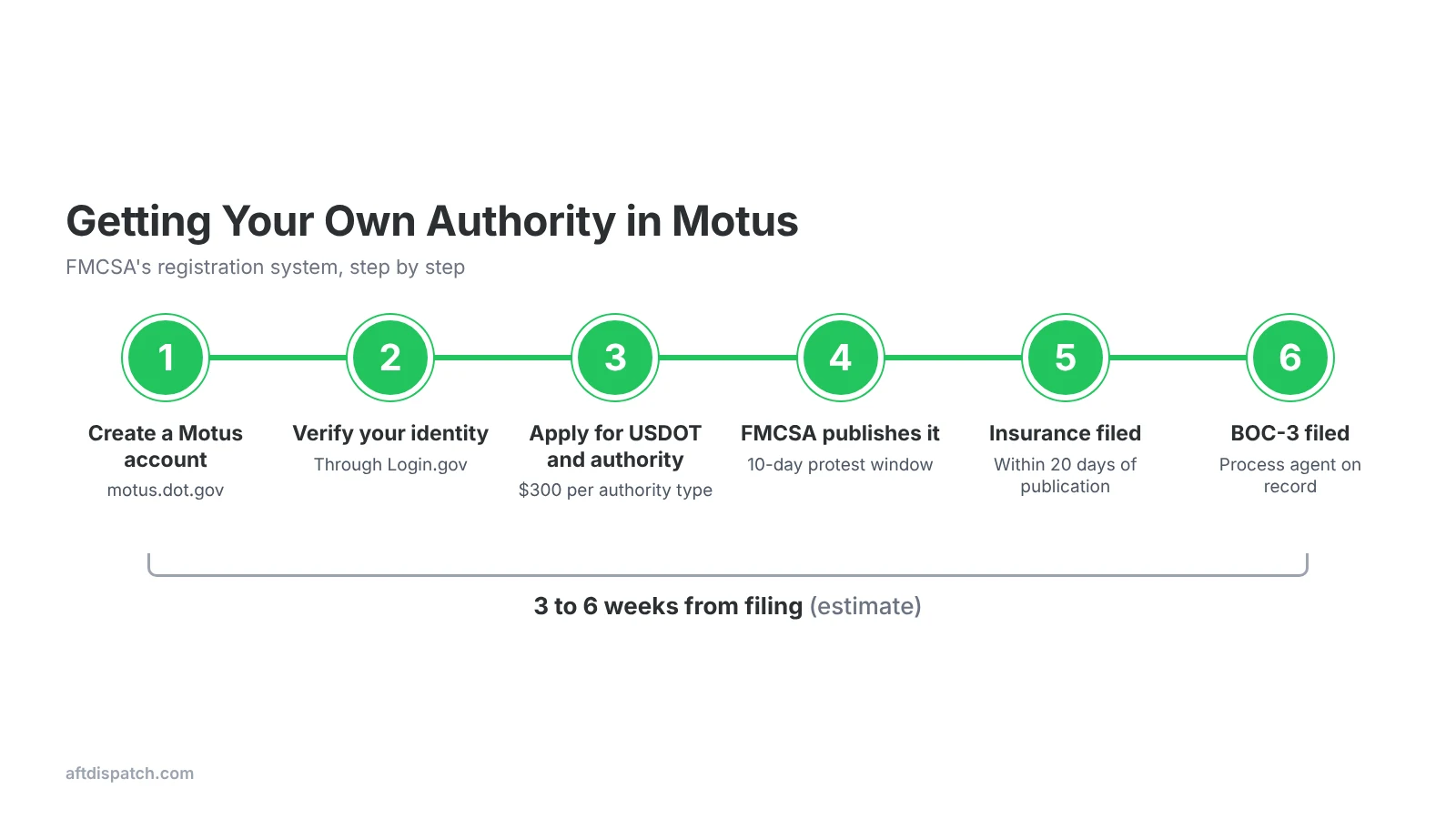
Truckstop’s step-by-step authority guide lays out the same sequence. FMCSA still issues MC numbers. It has said it may phase them out later in favor of the USDOT number, and it has set no date.
As an estimate, most new authorities are active and ready to haul 3 to 6 weeks after filing, assuming insurance and the BOC-3 are on file. Register for UCR in the same window. The guide to starting a trucking business covers the full authority process.
Insurance
New-authority commercial trucking insurance is expensive. Overdrive’s owner-operator insurance guide puts primary liability at $1,000,000 of coverage at about $10,000 or more a year, physical damage on the truck at about $5,000, and cargo at $1,000 or more. The total often reaches $20,000 or more a year. Many new authorities pay a down payment and finance the rest of the premium over the policy term, which turns insurance into a monthly bill that comes due in slow weeks too.
Proof of insurance has to reach FMCSA within 20 days of the application’s publication, and the authority does not activate without it. Most insurance agents file it once they issue a binder. I’ve watched new authorities lose weeks at this step by buying the cheapest policy and then finding that it didn’t meet a broker’s requirements.
IFTA, IRP, UCR and the 2290
Running interstate on your own authority adds 4 more registrations:
- IFTA (International Fuel Tax Agreement): a quarterly fuel tax report that splits the fuel tax you owe among states, based on the miles you ran in each.
- IRP (International Registration Plan): the apportioned plate, at about $1,500 to $3,000 a year per truck, and more for heavy, high-value trucks in high-cost states.
- UCR (Unified Carrier Registration): an annual federal fee based on fleet size. For 0 to 2 vehicles it is $46 for 2026 and $55 for 2027.
- Form 2290 (Heavy Vehicle Use Tax): up to $550 a year for a truck over 75,000 lbs.
The cost of authority guide breaks down what authority actually costs per year, filing by filing.
Finding Loads as a New Owner Operator
How you find loads depends on the path you chose.
Lease Purchase and Carrier-Leased Owner Operators
Loads come from the carrier’s dispatch desk. The driver gets a dispatch with origin, destination, pickup and delivery windows, and the pay, then accepts or rejects it through the carrier’s app. There is no broker contact, no rate negotiation and no load board work.
The trade is visibility. Many carriers don’t show drivers the gross rate on the load, only the driver’s own pay, so it is hard to check whether the carrier is keeping a fair percentage. Before signing, ask how percentage pay is calculated and whether it is figured on linehaul before or after the fuel surcharge.
Owner Operators with Their Own Authority
New authorities usually start on load boards. DAT and Truckstop are the main national boards, each sold as a monthly subscription. The driver searches by origin, destination, equipment and rate, then calls or messages the broker who posted the load.
The first call rarely turns into the load. Most new authorities are screened out before any rate talk starts. When a broker types a new MC number into its carrier-vetting platform, it sees an authority only weeks old, no Carrier Assure or Highway history, no DAT performance data and no insurance claims history. Many broker policies reject any carrier below a minimum authority age, whatever rate the carrier would take. I’ve watched new authorities spend their first weeks calling brokers who turned them down on authority age alone.
New authorities that book loads early usually do some of the following:
- Build a short list of brokers that work with new carriers. Some brokers specialize in it.
- Accept lower rates for a while to build a track record and a payment history.
- Work with a dispatch service in the early weeks, which brings the dispatcher’s existing broker relationships. (AFT Dispatch no longer offers dispatch services.)
Operational reality: Plan for a stretch of low or no revenue at the start, while broker approvals build. The truck payment, the insurance and your personal bills keep running through it.
The Cash Flow Problem Owner Operators Face
When an owner operator with their own authority delivers a load, the next step is an invoice to the broker. Standard broker payment terms run 30 to 45 days.
Here is how the timing plays out. A new authority books its first load in week 3 and delivers it in week 4. On 30 to 45 day terms, payment for that load arrives around week 8 to week 10. In the meantime, fuel for the next load is due at the pump, the insurance installment is due, and the truck payment is due.
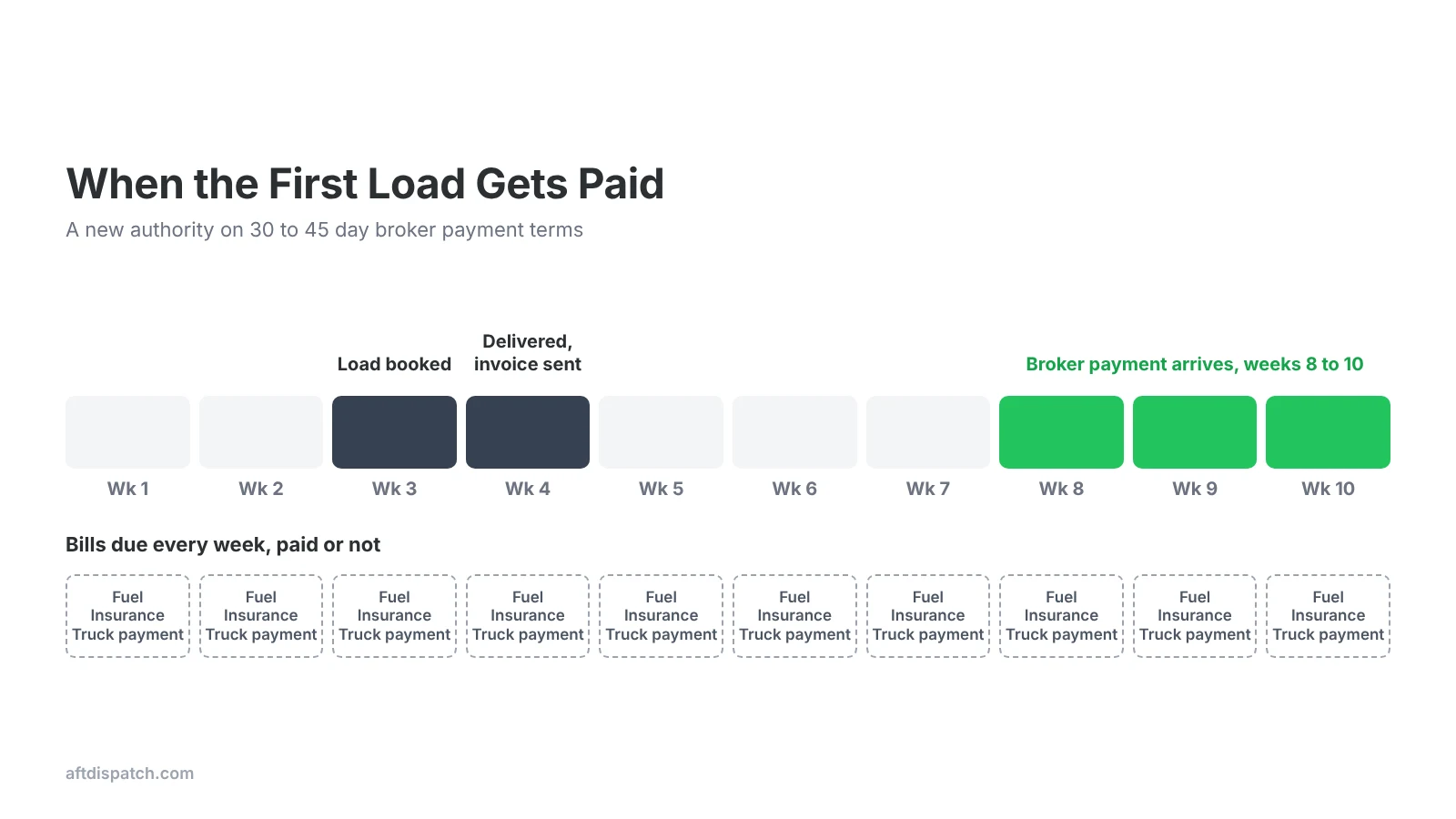
New own-authority carriers often look at freight factoring to cover that gap. A factoring company buys the broker invoice, advances most of its value to the carrier, and collects the full amount from the broker when it comes due.
The quoted factoring rate is only part of the cost. Many factoring agreements add a fee per invoice, plus a fee for each ACH transfer or wire. One carrier was quoted a 2% rate, with a $5 invoice fee, a $5 ACH fee and up to $35 in wire fees. Running 6 to 7 loads a week, the real cost landed near 6%. Before signing an agreement, add up every fee in it at the number of loads you expect to run.
Lease purchase drivers and carrier-leased owner operators don’t face this gap. The carrier pays them weekly out of its own cash flow. Factoring only comes into play when the owner operator holds the operating authority.
If this is the kind of operational detail you want more of, the 16-video factoring series goes deeper:
Surviving Year One
First-year failures tend to follow a few predictable patterns:
- A truck breakdown with no maintenance reserve. A single major repair can end the operation.
- An insurance lapse from a missed premium payment. The insurer notifies FMCSA, and the authority is revoked if the coverage isn’t replaced.
- A cash gap in the first weeks on your own authority, when bills come due before broker payments arrive.
- The lease purchase payment, which keeps coming out through home time, vacations and slow freight.
- Spending gross revenue as income, while the largest bills (taxes, maintenance and the insurance renewal) land later in the year.
The Reserve That Matters Most
First-year owner operators who make it through usually keep a maintenance and downtime reserve, separate from operating cash. ATBS clients spent about 14 cents a mile on maintenance in 2025, FreightWaves reported. On their average of about 95,000 miles, that comes to about $13,300 for the year (95,000 × $0.14). The spending arrives unevenly. Drivetrain repairs, after-treatment failures and tire replacements come with little warning, and an owner operator without a reserve ends up paying for them on credit cards, with the interest added to the next month’s bills.
Quarterly Tax Payments
Owner operators are self-employed, so nothing is withheld from their pay. The IRS expects quarterly estimated tax payments, due in April, June, September and January. An operator who doesn’t set money aside all year ends up facing a tax bill they can’t pay. The practice that holds up is to move a fixed share of every settlement into a separate tax account the same week it arrives, with the share set by your accountant from your own numbers.
What Owner Operators Actually Make
How much owner operators make depends on the path, the lane, the freight and how the business is run. The clearest current take-home benchmark comes from ATBS, an accounting firm that works with owner operators. ATBS put average owner-operator income for 2025 at $71,800. It changed its method for 2025, and like for like, income was roughly flat with 2024. Its clients averaged about 95,000 miles for the year.
Set that $71,800 next to the $73,639 median for irregular-route company drivers, and the 2 are close. The $170,000-plus that leased-on contractors were paid is the revenue their businesses took in. The ATBS figure is closer to what the owner kept after the truck’s costs.
The path changes how the income reaches you. A lease purchase driver is paid after the truck payment and the carrier’s deductions. A carrier-leased owner operator keeps a percentage or a per-mile rate and pays for the truck, fuel and maintenance out of it. An own-authority operator keeps all the revenue and pays every cost, including insurance and the authority filings. The higher incomes tend to come from specialized freight (flatbed, heavy haul, reefer in tight markets, hazmat tanker) and dedicated lanes with a single shipper. General dry van over-the-road work tends to pay less.
Common Mistakes New Owner Operators Make
- Buying too much truck. A new truck at several times the price of a well-maintained used one hauls the same loads at the same rates, and the bigger payment comes out of the same revenue.
- Skipping the pre-purchase inspection. A third-party inspection costs far less than the repairs it can catch.
- Buying the cheapest insurance policy. Some discount policies don’t meet broker requirements, and the carrier ends up replacing the coverage within weeks of starting.
- Filing for authority before insurance is lined up. FMCSA expects proof of insurance within 20 days of publishing the application, and the authority can’t activate without it, so a late policy pushes back the first load.
- Treating gross revenue as profit. Fuel, maintenance, insurance and tolls come out of every revenue dollar before the owner is paid. AFT Dispatch’s free Android app, Trucking Super Calc, works out your cost per mile, your break-even and your pay-yourself rate from your own numbers.
This is one piece of running a tighter operation. If getting paid is the piece you’re working through, the free 16-video factoring series covers what it actually costs:
Frequently Asked Questions
How long does it take to become an owner operator?
With a CDL and enough experience already in hand, the timeline depends on the path. Lease purchase is the fastest, since the carrier supplies the truck, the insurance and the plates, and a driver can start soon after the carrier approves them. A carrier-leased owner operator starts once the truck is bought and the carrier’s sign-on paperwork is done. Own-authority owner operators wait longest. As an estimate, a new authority is active 3 to 6 weeks after filing, assuming insurance and the BOC-3 are on file. That window covers FMCSA publishing the application, the 10-day protest period and the insurance filing. Booking the first load can take longer while brokers screen the new authority.
How much does it cost to become an owner operator?
On a lease purchase, the carrier supplies the truck, the insurance and the plates, so the out-of-pocket cost is mostly a personal cushion while settlements start. On your own authority, the verified line items include $300 per authority type paid to FMCSA, UCR at $46 for 2026, IRP plates at about $1,500 to $3,000 a year per truck, the 2290 at up to $550 a year, and insurance that often runs $20,000 or more a year for a new authority. On top of those come the truck or its down payment, the business setup, the BOC-3 and working capital for the weeks before broker payments arrive, and all of those vary by operator.
Do I need my own authority to be an owner operator?
No. Many owner operators run for years leased to a carrier under the carrier’s authority. They own the truck, keep most of the revenue, and let the carrier handle insurance, compliance, dispatch and the FMCSA paperwork. This path takes much less administrative work than running your own authority. Drivers usually move to their own authority when they want to keep all the revenue, choose which loads they accept, and build their own broker relationships instead of relying on the carrier’s freight. When they make that move, the application goes through FMCSA’s Motus system, and the insurance bill becomes theirs.
Is lease purchase worth it?
Lease purchase fits drivers who want a faster path to owning a truck than saving cash, who are comfortable being dispatched by 1 carrier, and who can hold a steady schedule for a multi-year term. Drivers who expect independence, want flexibility in lanes and home time, or underestimate how much the weekly truck payment takes out of a slow week get less from it. When freight slows, the payment stays the same while the settlement shrinks. Some lease purchase drivers walk away from the truck before the term ends, without ownership, because they could not keep up the payments through a soft freight market.
What’s the difference between an owner operator and an independent contractor?
In trucking the terms are often used interchangeably, and they describe different things. An owner operator owns the truck. An independent contractor is a tax and employment classification: a driver paid on a 1099 instead of a W-2, who is responsible for their own taxes, insurance and benefits. Most owner operators are independent contractors. Some independent contractors are not owner operators, such as a driver running a truck leased under a different arrangement. The IRS looks closely at this classification, and several states have tightened the rules on when a driver can be classified as an independent contractor.
How much do owner operators make per mile?
Revenue per mile depends on the freight and moves week to week. DAT’s national spot load board averages for the week of October 10 to 16, 2026 were $3.09 a mile all-in for van ($2.26 linehaul), $3.66 for reefer ($2.76 linehaul) and $3.64 for flatbed ($2.65 linehaul). All-in includes the fuel surcharge. Those are gross rates paid for the load. What the owner keeps per mile is the rate minus the truck’s own cost per mile, and that cost is different for every truck, so each operator has to work out their own.
Putting It Together
Becoming an owner operator starts with a CDL and enough experience to be insured, and then the path sets the work. A lease purchase gets you into a truck fast, with a payment the carrier deducts every week. Leasing to a carrier puts the truck in your name and leaves the freight and the filings with the carrier. Your own authority hands you the rest: the Motus filings, a first-year insurance bill that often runs $20,000 or more, broker screening, and invoices paid on 30 to 45 day terms.
On every path, the truck’s costs come out of the gross before the owner is paid, and the ATBS figure puts average owner-operator income close to the company driver median. The operators who get through the first year price loads against their own cost per mile, hold a maintenance reserve, set money aside for quarterly taxes, and keep enough cash on hand to cover the weeks before the first broker payments arrive.


Leave A Comment