
Table of Contents
Drivers ask me some version of this all the time, in the YouTube comments and on the phone: is owner operator worth it? It can be, for the right person with the right numbers. The problem is the order most people do it in. Most people sign for the truck first and run the numbers later, and only then find out the operation doesn’t work in the market they’re in, or under the terms they agreed to.
This post covers the decision itself: the 3 ways to become an owner operator, what each one puts on you in costs and responsibility, and the 3 numbers to run before you sign any paperwork. If you’ve already decided and want the full how-to, including the CDL, startup costs and business setup, our guide to the path to owner operator covers it step by step.
Is Being an Owner Operator Worth It? The Short Answer
Going owner operator is worth it when the rate your truck needs is a rate you can actually get on the freight you’d haul, and when you have the cash to carry the business through the weeks before you get paid. Both can be checked on paper before you sign for a truck.
The math comes down to 3 numbers:
- What the truck takes out of every dollar you’re paid.
- Your break-even per loaded mile, the lowest rate a load can pay without costing you money.
- The cash to get through the wait before brokers pay, plus a reserve for repairs.
Those numbers come out differently depending on how you go owner operator, because each of the 3 ways in moves a different set of costs and risks onto you. Pick the path first, then run the numbers for that path.
The 3 Ways to Become an Owner Operator
You can lease on to a carrier, you can do a lease purchase through a carrier, or you can run under your own authority. Here is what each one means in practice:
- Leasing on: you own the truck and run it under the carrier’s authority. You bring the equipment, but you aren’t the carrier.
- Lease purchase: you get the truck through the carrier and pay for it out of your settlements.
- Your own authority: you hold your own MC number and USDOT number, which makes you the trucking company.
Each path puts a different amount of risk on you, and a different return comes with it. You want a split that works in your favor, where the return is worth the risk and the responsibility you take on. The chart below shows who holds what on each path.
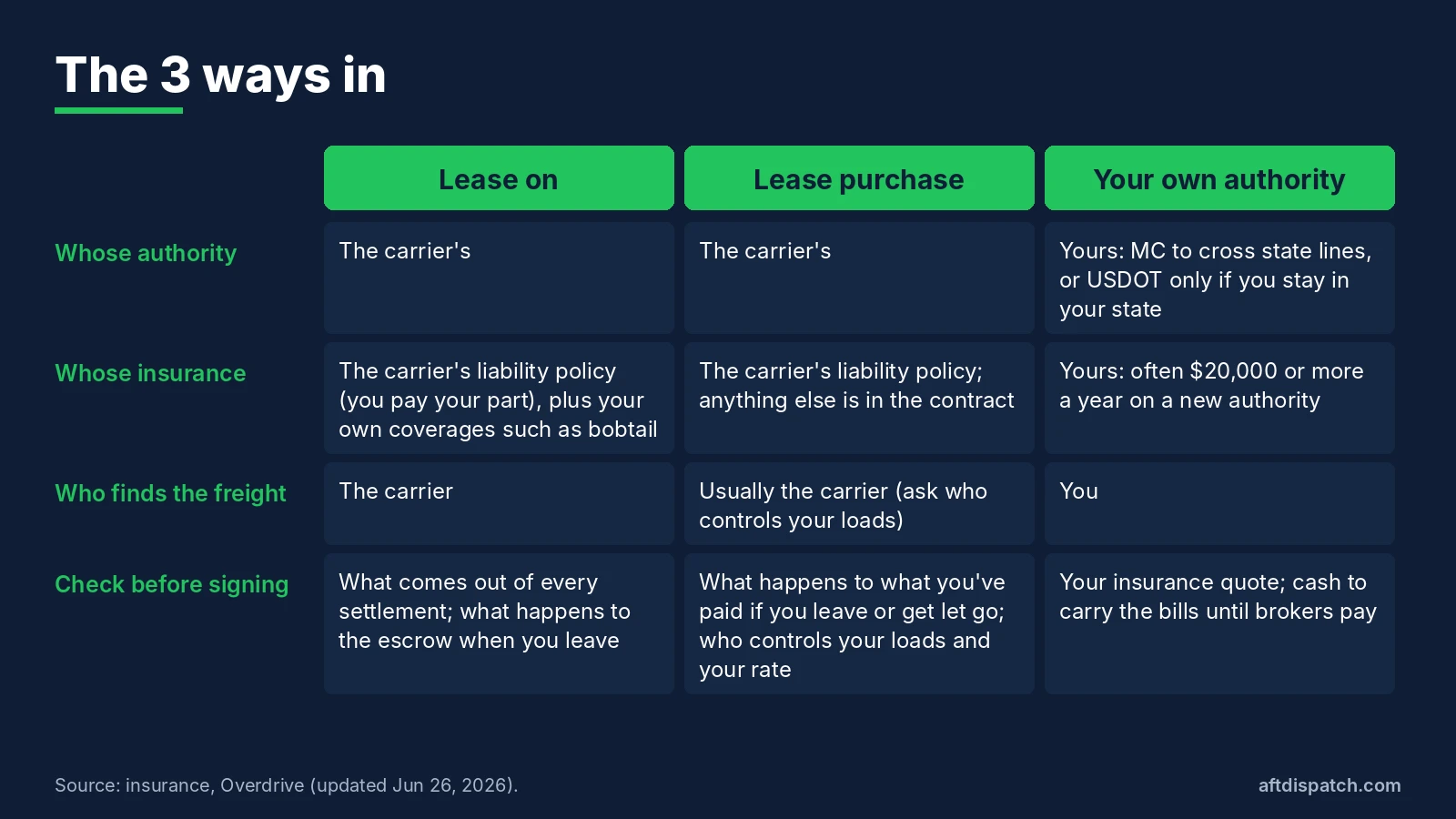
The next 3 sections cover what to check before you sign on each path. The requirements, the setup steps and how loads work on each one are in our full guide to the owner operator transition, so this post stays on the decision.
This is one piece of running a tighter operation. If getting paid is the piece you’re working through, the free 16-video factoring series covers what it actually costs:
Leasing On to a Carrier
When you lease on, you run under the carrier’s MC authority, usually with its liability insurance and its freight. That freight can come from different places depending on the carrier: a brokerage, direct customers, or freight forwarders. However the carrier gets it, your loads come through the carrier.
What you pay for on this path:
- the truck, and most likely a trailer;
- fuel and maintenance;
- your part of the liability policy you run under, since it’s the carrier’s authority;
- your own coverages, such as bobtail and any other insurance you choose to carry.
The carrier will often hold an escrow, money held back from your settlements that stays with the carrier for as long as you’re leased on. Read the lease for 3 answers before you sign:
- What comes out of every settlement.
- Which of those deductions you can expect to repeat every week.
- What happens to the escrow when you leave.
Ask the third question even if you plan to stay. Very rarely does anyone stick with 1 company and retire there, unless they’re only a few years from their planned retirement. For a lot of drivers, leasing on is where they learn what a truck really costs before going any further.
Lease Purchase: What to Find Out Before You Sign
In a lease purchase, you get the truck through the carrier and pay for it out of your settlements. Keep this background in mind before you read any agreement. In January 2025, the federal Truck Leasing Task Force recommended that Congress ban carrier lease-purchase programs (FreightWaves, January 22, 2025). Congress hasn’t banned them. A House bill, H.R. 8870, was ordered reported in committee in May 2026, and the Congressional Research Service report, last updated in September 2026, shows no ban enacted. Lease-purchase programs are still out there.
Before you sign a lease-purchase agreement, get clear answers to these:
- What happens to everything you’ve paid if you leave or get let go? Those payments are meant to be your equity in the truck. Find out in writing whether any of it stays with you.
- Who controls your loads?
- Who controls your rate?
The last 2 questions carry extra weight here, because in a lease purchase the truck payment comes out of your settlement either way. If the carrier decides which loads you get and what they pay, it also decides how much is left after the payment comes out.
The outcome to avoid goes like this: you spend months working just to cover the truck, then you leave or get let go, and the equipment and everything you paid into it stays with the carrier, with nothing left for you.
Running Under Your Own Authority
The third way is your own authority: your own MC number if you want to cross state lines, or just a USDOT number if you plan to stay local inside your state. On this path you are the trucking company. The insurance and the filings are yours, and you find your own freight, whether you get it all direct, all from brokers, or some of each.
Insurance and Filings
Insurance on a new authority often runs $20,000 or more a year (Overdrive). Have that money lined up before you count on running under your own MC.
The filings come on top of that. The 2290 Heavy Vehicle Use Tax is up to $550 a truck. It applies to trucks at a taxable gross weight of 55,000 lbs or more, and the $550 maximum applies at 75,000 lbs or more (J. J. Keller). You also have UCR, IRP plates and quarterly IFTA filings. I broke those down in the post on recurring compliance costs, which has its own video. A new authority also goes through the FMCSA new entrant audit, and the step-by-step for starting a trucking business covers the rest of the setup.
The Wait to Get Paid
Brokers pay weeks after delivery, and you carry the bills in between. A lot of drivers I’ve talked to didn’t know this part. They figured they would deliver the load and get their money. There are ways to get paid sooner, and each of them costs you something, so the wait belongs in your numbers from day 1.

The 3 Numbers to Run Before You Sign
Whichever path you choose, run these 3 numbers on the specific truck you’re looking at before you sign anything.
1. What the Truck Takes Out of Every Dollar
Out of every dollar a broker or a direct customer pays you, part goes straight to running the truck. That part is your operating cost, and you need it however you get your freight. Until you know it, you can’t tell whether a rate leaves anything for you.
2. Your Break-Even Per Loaded Mile
Your break-even per loaded mile is the lowest rate a load can pay you without costing you money. It’s figured per loaded mile because loaded miles are the ones that get paid, and they have to carry the cost of your empty miles too. If you don’t know this number, you’re flying blind every time you take a rate.
3. Cash for the Wait, Plus a Repair Reserve
The third number is the cash to get through the weeks before brokers pay, plus a repair reserve. ATBS puts maintenance at about 14 cents a mile (FreightWaves). Use that as a starting point, then size the fund to your truck’s age, condition and service record. The older and more worn the truck, the bigger the repair fund you’ll want. Plan a replacement fund as well, because every truck eventually reaches the point where it isn’t worth repairing.
I walk through all 3 in more depth in the post on the 3 numbers most owner operators skip, and in this video:

Run the Truck Before You Buy It
You don’t need a spreadsheet or a sheet of paper for these numbers. I built Trucking Super Calc, a free Android app, to work them out on your phone. It runs only on Android and sends nothing to me.
The point is to run the truck you’re looking at before you sign for it. You simulate the operation and see whether it fails before it starts, or worse, whether you’d spend money you can’t recover and end up upside down on the truck.
- Enter the truck payment, the insurance quote and the miles you expect to run, along with the rest of your costs.
- Enter the pay you want to take home. The business has to pay you as well as cover its operating costs, so this number belongs in the math.
- Read your Pay Yourself rate: what your loads have to pay per loaded mile to cover your costs and your pay.
- Open If Your Miles Fall Short. It shows the same rates at 10%, 20% and 30% fewer miles.
That last table shows what happens when something goes wrong, such as a stretch where you can’t get loads or you end up deadheading far more than you planned. The truck payment and the insurance don’t drop off when the miles do. Those fixed costs stay owed in full, so every mile you do run carries more of them, and the rate you need climbs.
The more accurate the numbers you put in, the more accurate the results. If you’re already running, update them as they change. Each time diesel moves, for example, you can see how it changes your operating cost and whether a load at a slightly lower rate still pays.
When Owner Operator Is Worth It
With the numbers in hand, the question has an answer. Going owner operator is probably worth it when all of these are true:
- The rate your truck needs is a rate you can actually get on the freight you’d haul.
- You have cash for the wait, plus a separate reserve for repairs.
- You’re ready to run the business side: billing, insurance, the filings covered above, and saying no to bad loads.
If the math only works in your best week, you’re not ready. The If Your Miles Fall Short table makes a good test: if the rate you’d need at 20% fewer miles is out of reach on the freight you’d haul, the plan depends on every week going right.
Separate from this, if you factor your invoices or you’re about to, my free 16-video series walks through the real costs and the traps:
Staying a Company Driver for Now
If the numbers don’t work yet, there’s nothing wrong with staying a company driver for now. A steady paycheck with no truck payment is a real advantage while you save and learn. Plenty of good owner operators drove company first and knew their numbers before they bought. They had the operation simulated and thought through while they were still earning a paycheck.
Use that time to compare. You can run the app on a truck you’re only thinking about, so put 3 trucks you’re considering side by side with their costs, or 3 trailers. Add the lease terms, the insurance quotes and the taxes for each, then write it all down and compare. That way the decision you make is an educated one.

The same approach settles owner operator vs company driver for your own situation. Set your target pay to what you earn as a company driver now, and the Pay Yourself rate shows what your loads would have to pay per loaded mile to match it.
Frequently Asked Questions
Is lease purchase worth it, and what should I find out before signing?
That depends on the specific contract, so judge the agreement in front of you. Before signing, get 3 answers in writing: what happens to everything you’ve paid if you leave or get let go, who controls your loads, and who controls your rate. The truck payment comes out of your settlement either way, so a carrier that controls both your loads and your rate also controls what’s left after the payment. Keep in mind that the federal Truck Leasing Task Force recommended in January 2025 that Congress ban carrier lease-purchase programs. No ban has been enacted, so the programs are still offered, and those 3 answers tell you whether this one is worth signing.
Should I stay a company driver first?
If you haven’t run the numbers on a specific truck yet, staying a company driver while you do is a reasonable choice. A steady paycheck with no truck payment gives you time to save the cash for the wait between delivery and payment, and to build a repair reserve. Use that time to run the trucks you’re considering, with real insurance quotes and lease terms. Set your target pay to what you earn now, and you’ll see the rate your loads would need to pay to match it. If that rate is one you can actually get on the freight you’d haul, the move starts to make sense.
How much money do I need before going owner operator?
No single figure fits every path, so work it out from the 3 numbers on the truck you’re looking at. Start with what the truck takes out of every dollar and your break-even per loaded mile, so you know what the operation has to earn. Then the cash: enough to carry the bills through the weeks before brokers pay, plus a repair reserve. ATBS puts maintenance at about 14 cents a mile, and your own reserve should be sized to your truck’s age and condition. On your own authority, add insurance, which often runs $20,000 or more a year for a new authority, and the 2290, which is up to $550 a truck.
Can I run the numbers before buying a truck?
Yes. Trucking Super Calc, the free Android app I built, lets you run the truck you’re looking at before you sign for it. Enter the truck payment, the insurance quote, the miles you expect to run, the rest of your costs and the pay you want to take home. It gives you a Pay Yourself rate, which is what your loads have to pay per loaded mile. The If Your Miles Fall Short table shows that rate at 10%, 20% and 30% fewer miles, because the truck payment and the insurance stay owed in full when the miles drop. The app works offline and sends nothing to AFT.
Owner operator lease vs own authority: which is better for me?
It depends on how much of the business you’re ready to carry. Leased on, you run under the carrier’s MC authority, usually with its liability insurance and its freight, and you pay for the truck, fuel, maintenance and your own coverages. The carrier often holds an escrow, so read what comes out of every settlement and what happens to the escrow when you leave. With your own authority, the insurance, the filings and the freight are all on you. Insurance on a new authority often runs $20,000 or more a year, and brokers pay weeks after delivery. Run your break-even for both setups before you pick.
Running your numbers is one side of the business. Getting paid is another. My free 16-video series breaks down what factoring really costs:
The Math Comes Before the Paperwork
Put the truck you want, its insurance quote and the miles you expect into the numbers for the path you’re choosing, and do it before anything gets signed. If the rate it needs is one your freight actually pays and the cash for the wait is in place, the move can work. If the plan only clears in your best week, keep the paycheck and run the numbers again when something changes, such as a better insurance quote or a cheaper truck.




Leave A Comment