

Table of Contents
A lot of new owner-operators budget the truck, the trailer, the fuel, and the insurance, and they think the costs are covered. Then the government bills start showing up. The 2290, the apportioned plates, the fuel tax filings, the registration fees. None of them came up when you bought the truck, and together they catch people off guard every year.
This is the recurring cost of trucking authority: the compliance and tax line items that keep your authority legal and current, beyond the truck and fuel most operators already plan for. None of these is large on its own, but they stack, and because most are annual or quarterly rather than per-load, they are easy to forget until the deadline arrives. This guide walks through the full stack, what each one costs in 2026, and how to fold it back into your cost per mile. The figures are ranges that vary by state, jurisdiction, weight, and miles, so treat them as the shape of the cost rather than your exact number.

Companion video: The Cost of Keeping Your Authority Legal (AFT Dispatch).
The 2290 Heavy Vehicle Use Tax
Start with the federal one. The 2290, or Heavy Vehicle Use Tax, is an annual federal tax on trucks that run 55,000 pounds or more taxable gross weight. The amount runs by weight, from about $100 a year at the bottom up to $550 at the top. A loaded tractor usually runs around 80,000 pounds, and anything over 75,000 pounds owes the maximum, so most owner-operators with a sleeper and a loaded trailer are paying the full $550 a year. It is one of the few numbers on this list that is the same no matter what state you call home.
The 2290 tax period runs July 1 through June 30, which trips up operators who assume it follows the calendar year. You file it on IRS Form 2290, and the piece that matters operationally is what you get back: a stamped Schedule 1. That document is your proof of payment, and you need it before you can register apportioned plates or renew them. So the 2290 is not just a tax bill. It is the gate you pass through before the rest of your registration works. An operator who lets the 2290 lapse does not just owe the tax, he finds his plate renewal blocked until the Schedule 1 is current, which can park the truck at exactly the wrong time.
IRP and Apportioned Plates
As an interstate carrier, you do not run a normal state plate. You run an apportioned plate through the IRP, the International Registration Plan, and it replaces your regular plate. You need it if you run in two or more jurisdictions and your power unit is 26,001 pounds or more, or has three or more axles. That threshold covers essentially every owner-operator running interstate. A truck at 26,000 pounds or under, or one that stays inside a single state, keeps a normal plate and skips this entirely.
Here is how it works. You register once, in your base state, and the fees get apportioned out to each state based on your share of miles run there. That is why there is no flat national number. What you pay depends on your base state, your truck’s weight and value, and where you actually drive. As a working range, plenty of operators land somewhere between $1,500 and $3,000 a year per truck, and a heavy, high-value truck based in a pricey state can run past $3,000. Two operators with identical trucks can pay very different apportioned fees simply because they are based in different states and run different lanes.
One detail catches new accounts. When your IRP account is brand new, you have no mileage history yet, so the state has you estimate your mileage for the first year. They true it up later against what you actually ran. So your first year is an educated guess, and your real apportioned cost settles in after that, once a full year of mileage by state is on the books. Budget the high end of the range your first year, because an underestimate now becomes a balance owed at the true-up.
If you want this kind of operational breakdown on the rest of running a truck, the free trucking education at AFT Dispatch goes deeper:
IFTA: The Quarterly Fuel Tax
IFTA, the International Fuel Tax Agreement, is the one that trips people up the most, usually because they confuse it with IRP. Keep them straight: IRP is your registration, your plate. IFTA is your fuel tax. Same kind of vehicle, the 26,001-pound or three-axle interstate trucks, but two separate systems with two separate filings.
You get one IFTA license and a set of decals from your base state, renewed every year. The license and decals are often free or a small fee, depending on your state, so the sticker itself is cheap. The real cost of IFTA is the filing. Every quarter you file one consolidated return through your base state, reporting your miles and your fuel by jurisdiction, every state you ran in and fueled in. The return reconciles what you owe or get credited in each state, based on where you drove versus where you bought your fuel. The principle is that you pay fuel tax where you ran the miles, not just where you pumped the diesel, and the quarterly return squares it up.
The discipline IFTA demands is the recordkeeping. You file every quarter even if you ran zero miles, so a slow quarter does not get you out of the paperwork. Miss a filing, or run on an invalid IFTA, and a roadside violation runs roughly $100 to $500 depending on the state. That is why the trip sheets and fuel receipts matter: the filing is only as accurate as the records behind it, and a sloppy quarter is the kind of thing that turns a routine inspection into a fine.
The money side of trucking, the costs and mechanics of running a truck as a business, is exactly what the free AFT Dispatch education covers:
The Rest of the Stack
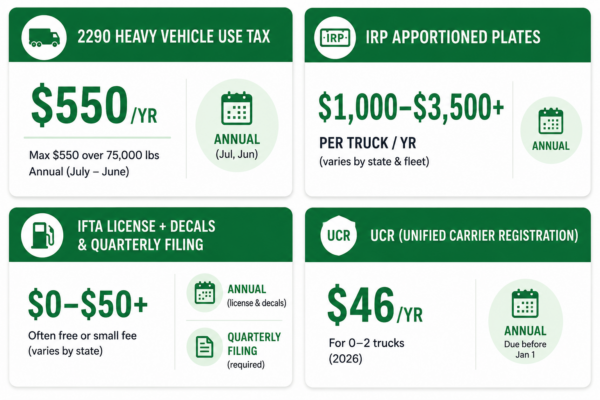 A few more pieces round out the cost of authority. UCR, the Unified Carrier Registration, is a flat annual federal fee by fleet size. For an owner-operator with zero to two trucks, that is $46 for 2026, unchanged from 2025, and it is due before January 1. It is small, but it is one more thing with a hard deadline, and missing it can mean roadside enforcement until it is paid.
Then there are state permits, which vary by state, and the occasional trip or oversize permit when you run somewhere your apportioned plate does not cover. All of it comes with recordkeeping: trip sheets, fuel receipts, and miles by state. That paperwork is itself a real cost, because it takes time, and your time has a value whether you bill it or not. Most operators either spend the hours on it or pay a permit and filing service to handle it, and either way it belongs in the cost of authority.
Weight-Distance Tax States
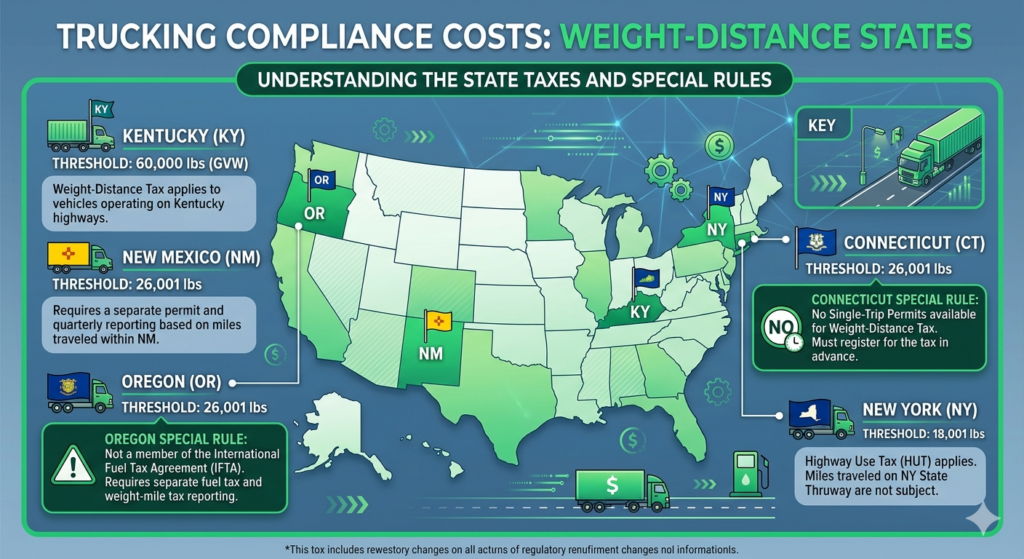
A handful of states charge a weight-distance tax that sits on top of IFTA and IRP, not inside them, and they catch operators who assume their plates and fuel license cover everything. These are separate registrations with their own filings, and the thresholds are lower than you might expect.
Kentucky’s KYU applies to trucks 60,000 pounds and up. New Mexico, Oregon, and Connecticut start at 26,001 pounds, the same threshold as IRP. New York’s HUT starts lowest of all, at 18,001 pounds. Two of these carry special handling worth knowing before you route a load through them. Oregon is not part of IFTA at all, so it runs its own weight-mile tax and requires a permit before you fuel or operate in the state. Connecticut offers no temporary trip permit, which means you have to register fully before you enter, not at the line.
For the others, the handling is more forgiving. New York, Kentucky, New Mexico, and Oregon all offer temporary trip permits if you only pass through occasionally, so you do not need full registration for a one-off load. On filing frequency, New York, Kentucky, and New Mexico file quarterly, while Connecticut files monthly. If any of these states sits on a lane you run regularly, the registration and filing become part of your recurring cost, not a one-time setup.
If you are totaling up your own cost of authority and want the rest of the operational picture, the full library of free trucking education is below:
What It All Adds Up To
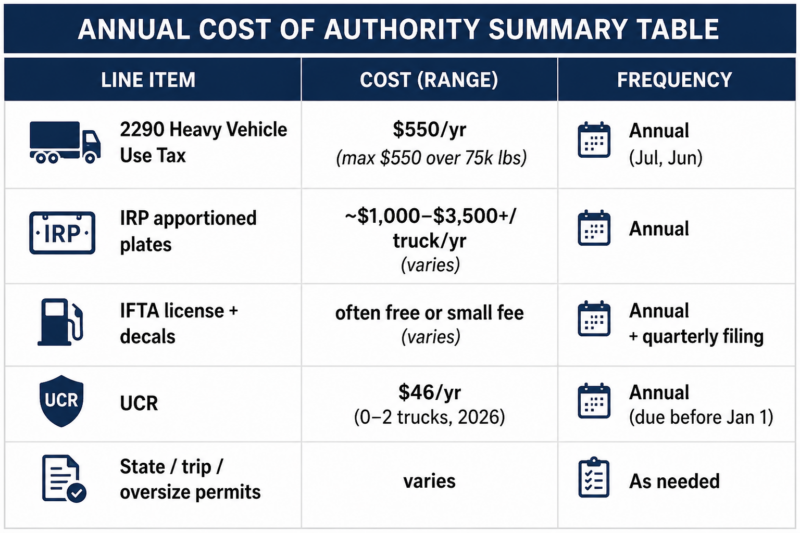
Here is the point, and it ties back to cost per mile. None of these line items is huge on its own, but they stack up, and most of them are annual or quarterly rather than per-load, so they do not show up when you are looking at a single rate the way fuel does. That is exactly why new operators forget to budget for them, then get surprised when four bills land in the same quarter.
The disciplined move is to total your annual cost of authority, all of it, and divide it down into a monthly or per-mile figure. Add up the 2290, the apportioned plates, the UCR, any weight-distance registrations, and the permits, spread it across your miles for the year, and it lands as a few cents a mile. Small per mile, but real, and it comes out of the same pocket as everything else. Folding it into your cost-per-mile number is what keeps it from being a surprise.
Authority costs are the line items that do not announce themselves on any single load, which is precisely why the operators who budget for them stay ahead of the ones who do not. Total them once, divide them down, and they stop being a surprise.
Frequently Asked Questions
How much does it cost to keep trucking authority active per year?
There is no single national figure, because most of the cost varies by state, weight, and miles. As a 2026 picture for one truck: the 2290 runs $100 to $550 a year (most loaded tractors owe the $550 maximum), IRP apportioned plates commonly run $1,500 to $3,000 or more, IFTA’s license is often free or a small fee with the real cost in the quarterly filing, and UCR is $46 for zero to two trucks. Add any weight-distance registrations and permits on top. Total your own line items, since base state and lanes move the number significantly.
What is the difference between IRP and IFTA?
They apply to the same trucks, the 26,001-pound or three-axle interstate vehicles, but they are two separate systems. IRP is registration: it replaces your normal plate with an apportioned plate, and the fees are split among the states you run based on mileage. IFTA is fuel tax: it reconciles what you owe or are credited per state based on where you drove versus where you fueled. You register IRP once a year and file IFTA every quarter. Operators confuse them because both are base-state credentials, but they are different bills on different schedules.
Do I have to file IFTA if I did not run any miles?
Yes. IFTA returns are due every quarter even if you ran zero miles. A slow or idle quarter exempts you from owing tax, not from filing. Skipping a filing, or running on an invalid IFTA, exposes you to a roadside violation of roughly $100 to $500 depending on the state. File every quarter on time regardless of activity, and keep your trip sheets and fuel receipts current so the return is accurate.
Which states charge a weight-distance tax on top of IFTA and IRP?
Five states assess a weight-distance tax separate from IFTA and IRP: Kentucky (KYU, 60,000 pounds and up), New Mexico, Oregon, and Connecticut (all at 26,001 pounds), and New York (HUT, at 18,001 pounds). Oregon is not part of IFTA, so it runs its own weight-mile tax and needs a permit before you operate there. Connecticut offers no temporary trip permit, so you must register fully before entering. New York, Kentucky, New Mexico, and Oregon offer trip permits for occasional travel. Filing is quarterly for New York, Kentucky, and New Mexico, monthly for Connecticut.
Budgeting for the Whole Stack
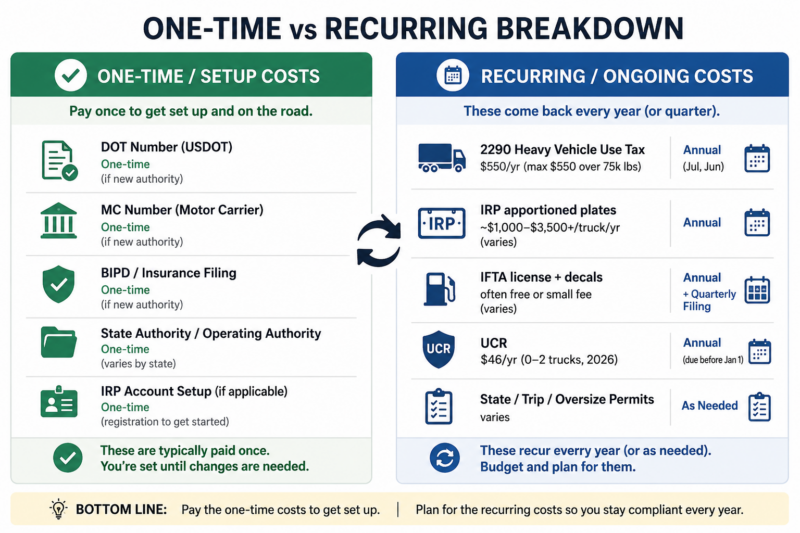
The cost of trucking authority is not one bill, it is a stack of them spread across the year: the 2290 in the summer, IRP at registration, IFTA every quarter, UCR before January, and weight-distance filings wherever your lanes take you. Each is manageable on its own. The operators who get caught are the ones who never added them up, so the bills feel like surprises instead of line items. Total the stack once, divide it into a per-mile figure, fold it into your cost per mile, and the whole thing becomes what it should be: a known, planned-for part of running a legal truck.




Leave A Comment