

Table of Contents
Most owner operators who go broke skip the same 3 numbers. The first is what the truck takes out of every dollar a broker pays. The second is the break-even rate on each load. The third is the cash to get through the wait between delivering a load and getting paid for it.
That is the short answer to why owner operators go broke. When you run your own truck, money and bills arrive out of order. A good week of settlements lands before the fuel and insurance bills do. A load offer comes in on the phone before you know what the load needs to pay. The broker pays weeks after the freight is delivered. Each of the 3 numbers puts one of those back in order.
None of them takes more than a calculator and your own bills. Below, each one is worked through with an example truck, so you can run yours before you buy a truck, or before your next insurance renewal.

The Truck Gets Paid First: Where Owner Operator Expenses Go
Say you run your own truck. A good week of settlements hits the account, and it feels like pay. That money belongs to the truck first. Fuel, insurance, maintenance and the truck payment all come out of it before any of it is yours.
The Gap Between Gross Pay and Income
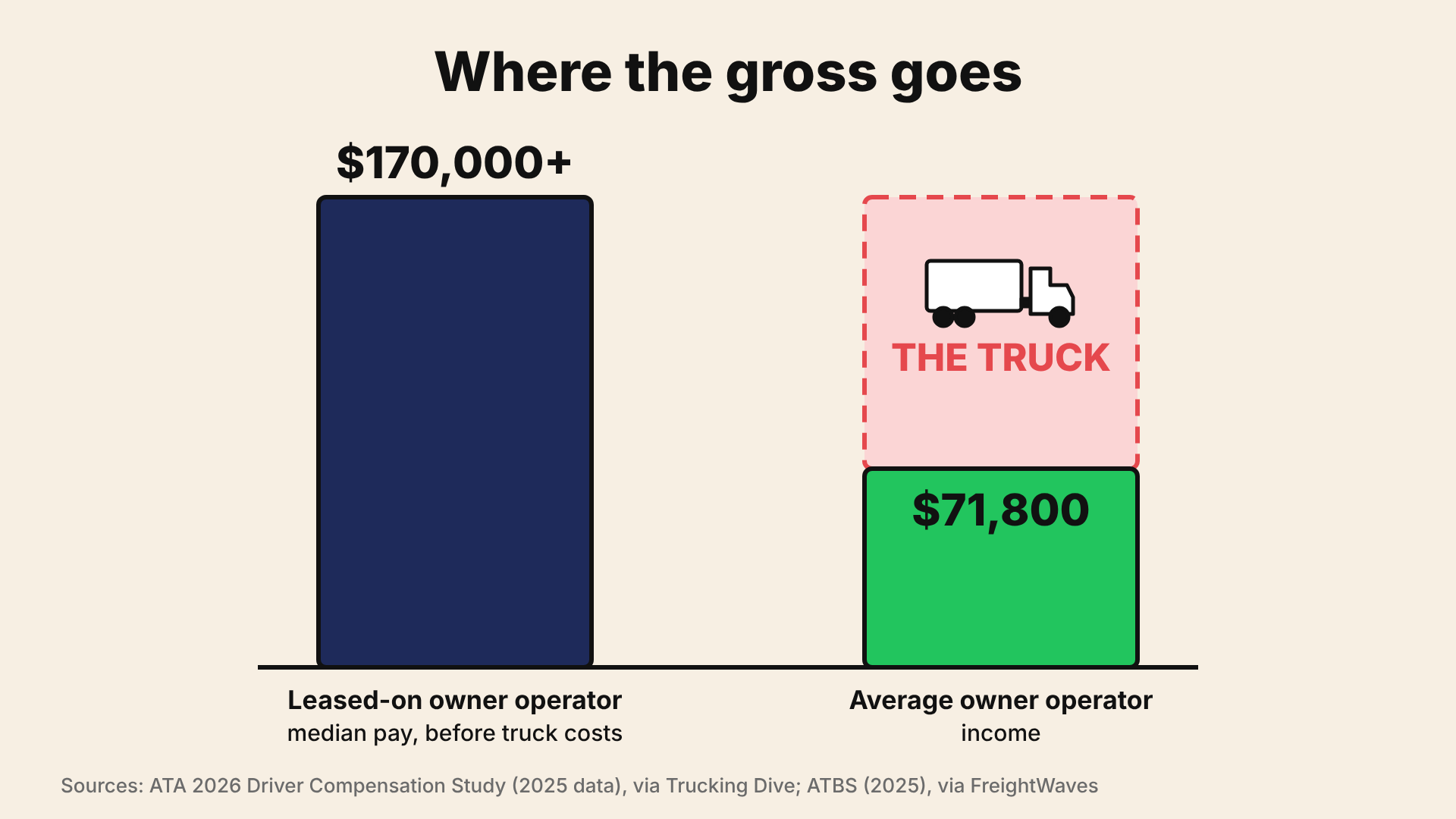
The size of the truck’s share shows up when you put 2 industry numbers side by side. Carriers paid leased-on owner operators a median of more than $170,000 in 2025, according to the ATA’s 2026 Driver Compensation Study, as reported by Trucking Dive. That is what the carrier paid the contractor. The contractor runs his own truck, so the truck’s costs still come out of that money.
ATBS, a firm that does the books for owner operators, put average owner operator income at $71,800 for 2025, as reported by FreightWaves.
The 2 figures come from different surveys of different groups of operators, so read the gap as a rough size, with no exact dollar figure attached. Most of the distance between them is the truck.
Running your numbers is one side of the business. Getting paid is another. My free 16-video series breaks down what factoring really costs:
Fuel Is the Biggest Piece
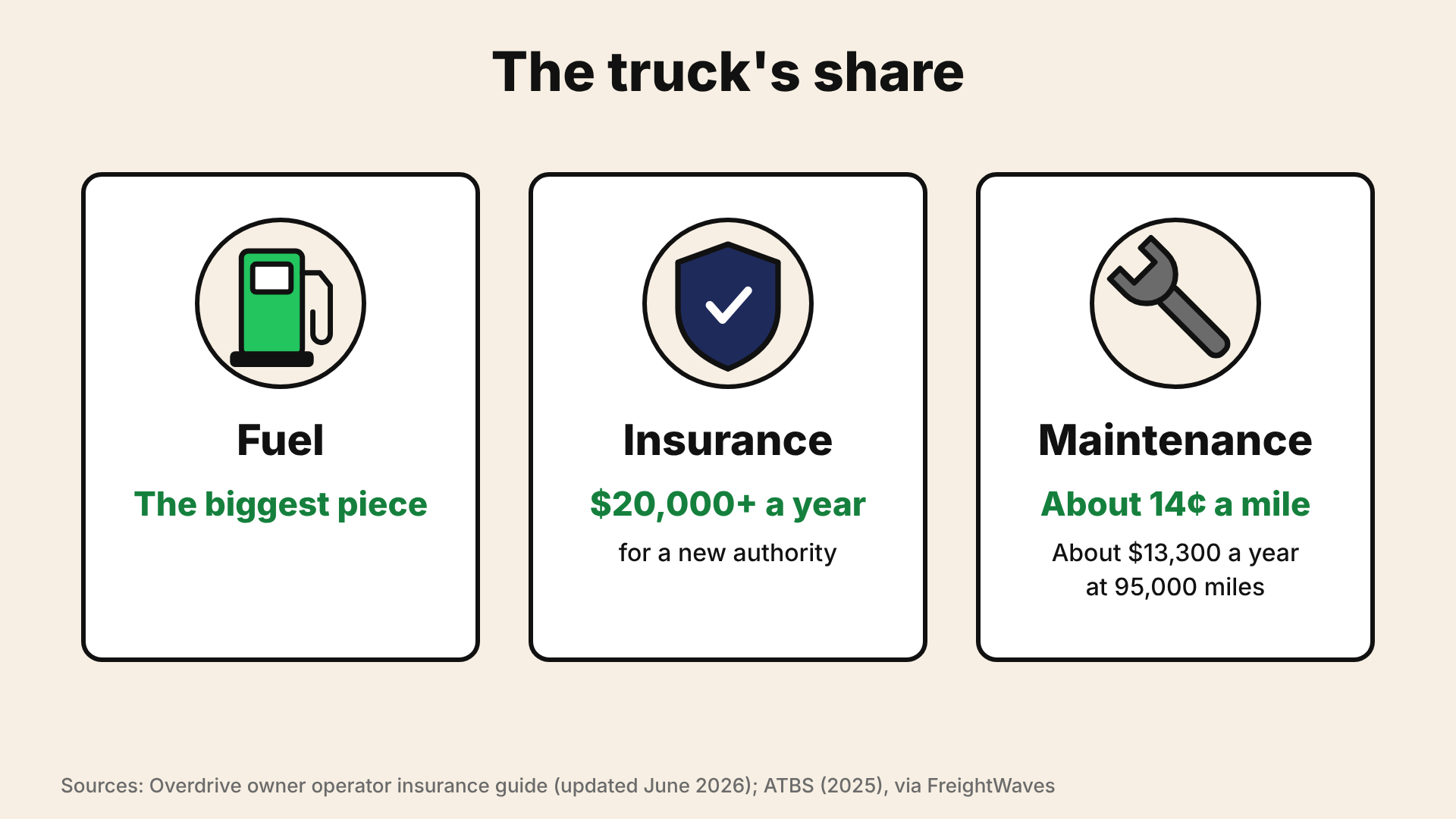
Fuel is the largest single cost of running the truck, and it moves the fastest. Every time the pump price moves, your cost moves with it. A rate that covered your costs at last month’s diesel price can fall short this month, with nothing else in the business changed.
Fuel is also paid at the pump, on the day you burn it. The load that burned it pays you weeks later. That timing comes back in the third number.
Insurance on a New Authority
Insurance on a new authority often runs $20,000 or more a year, according to Overdrive’s owner operator insurance guide. That estimate covers primary liability, physical damage, cargo and non-trucking liability, and it assumes a safe driving record. A newer authority or a rough record can push it higher.
The premium is due whether the truck runs or not. A week in the shop does not change the payment, and neither does a week at home. Insurance is also 1 line among several in the cost of trucking authority, which adds the 2290, IRP, IFTA and UCR on top.
Maintenance at About 14 Cents a Mile
ATBS puts maintenance at about 14 cents a mile, per the same FreightWaves report. Say your truck runs 95,000 miles a year. At 14 cents a mile, that is about $13,300 a year (95,000 × $0.14).
That $13,300 does not arrive in 12 even monthly pieces. It arrives as tires, a brake job, an injector or an aftertreatment repair, in big, uneven bills. Setting aside 14 cents for every mile, loaded or empty, builds the money before the bill lands. Without that set-aside, the repair gets paid out of whatever happens to be in the account that week.
Splitting the Truck’s Money From Your Pay
An operator who spends the gross like a paycheck is spending the truck’s money. The bills come due later, after the money is gone.
Every dollar a broker pays belongs to the truck until the truck’s bills are covered. What is left after that is your pay. In practice, that can be a simple routine:
- Settlements go into a business account.
- Fuel, insurance and the truck payment are paid from that account, and the maintenance set-aside moves to its own account.
- You pay yourself on a fixed schedule from what remains.
If what remains is smaller than you expected, you find out within weeks, instead of at tax time or when a payment bounces.
Know Your Floor: Break-Even Cost Per Mile
The second number is break-even. A lot of operators who go broke never worked it out, and they take loads by feel. Break-even is the lowest rate a load can pay without costing you money. Every load booked below that line costs you money to haul, even while it keeps the truck moving.
Start With Cost Per Mile
Say your cost per mile is $2.10. That is every bill divided by every mile, loaded and empty: fuel, insurance, the truck payment, maintenance, permits and the rest, over the total miles the truck drove. If you have not worked out your own number yet, how to calculate cost per mile walks through each line.
$2.10 is what it costs to move the truck 1 mile. A broker pays for fewer miles than that, and the check shrinks before it reaches you.
Worked Example: How $2.10 Becomes $2.66
The numbers in this section are an example. Run the same steps with your own percentages.
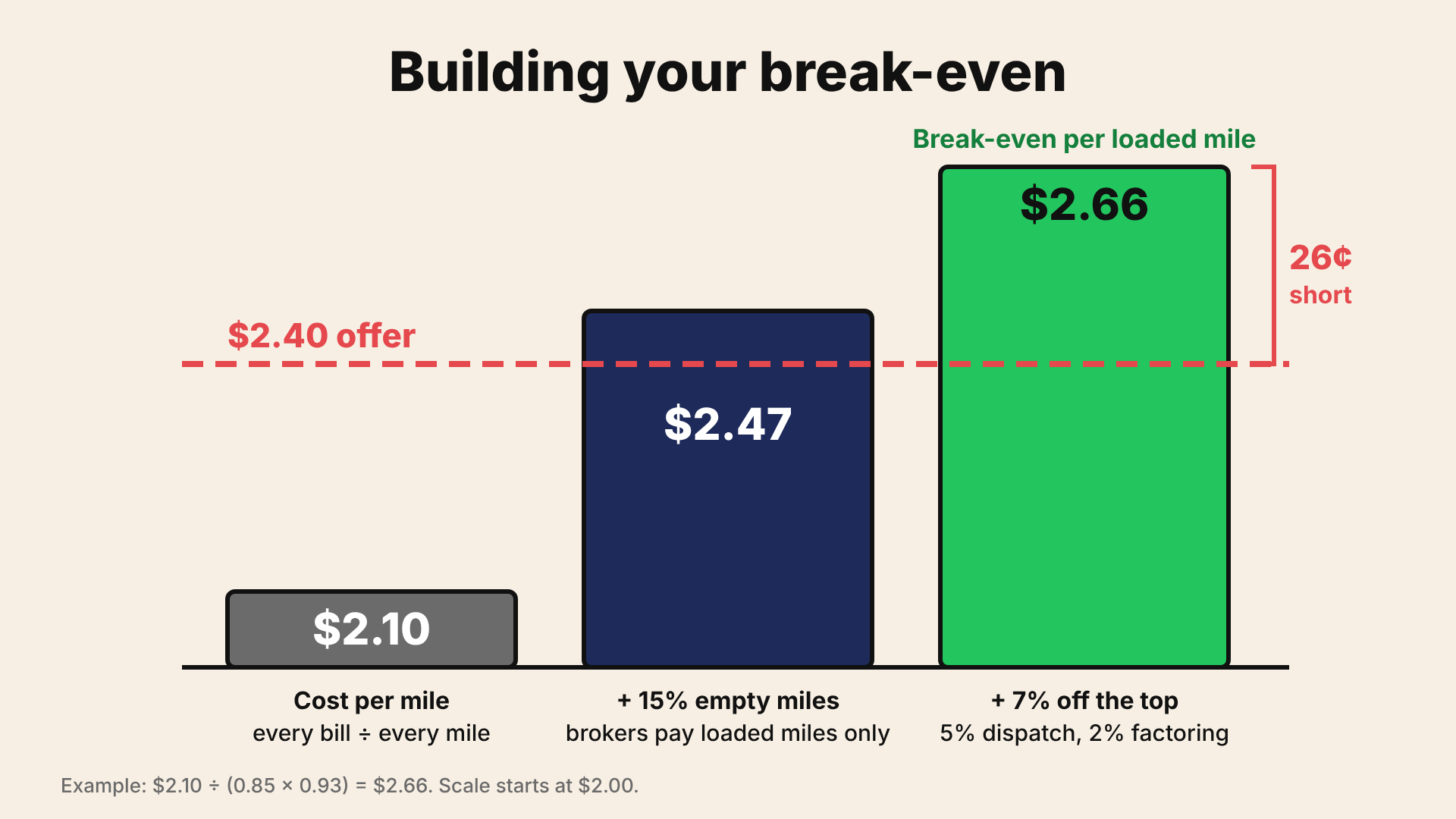
Brokers only pay for loaded miles. Say 15% of your miles are empty: deadhead to the shipper, repositioning after a delivery, the drive home. On 95,000 miles a year, 15% is 14,250 miles nobody pays for.
Now say 7% comes off the top of every load: 5% for dispatch and 2% for factoring. That 7% leaves before the money reaches your account.
Your $2.10 has to stretch over fewer paid miles, and part of every check is gone before it reaches you. The math takes 2 steps:
- Spread the cost over loaded miles only. $2.10 ÷ 0.85 = about $2.47 per loaded mile.
- Cover the 7% that comes off the top. $2.47 ÷ 0.93 = about $2.66 per loaded mile.
In 1 line: $2.10 ÷ (0.85 × 0.93) = $2.66. That makes your break-even $2.66 a loaded mile. That is the floor.
Your empty percentage and your fees will differ from these, so your floor will too. The steps stay the same.
If this is the kind of operational detail you want more of, the 16-video factoring series goes deeper:
Why a $2.40 Load Gets Booked
Now a broker offers $2.40. Set against the $2.10, it looks like money, 30 cents a mile above cost, so it gets booked.
Set against the $2.66 floor, the same load runs 26 cents short on every loaded mile. On a 1,000-mile load, that is $2,400 in gross and about $260 the truck has to make up from somewhere else.
Take enough of those loads and the truck stays busy while the account drains. The truck never stops, and the money still runs out. Operators in this spot usually find out at a repair or an insurance renewal, when the cash they thought they had is not there.
Work Out the Floor Before the Phone Rings
Work out the floor before the phone rings, and write it where you will see it when a broker calls. Then any load under it gets a counter or a pass.
A counter is your floor plus the margin you need, said as a number. If the broker will not get near it, pass. Some loads below the floor can still make sense, such as a short run that moves the truck out of a weak market and into a stronger one. That call gets made on purpose, with the floor in front of you, instead of by feel on the phone.
If you would rather not run the division on every call, I built an app that checks whether a load pays. Trucking Super Calc is free on Android. It works out your break-even per loaded mile from your own costs, then grades a load offer against it before you book.
The Wait to Get Paid: Owner Operator Cash Flow
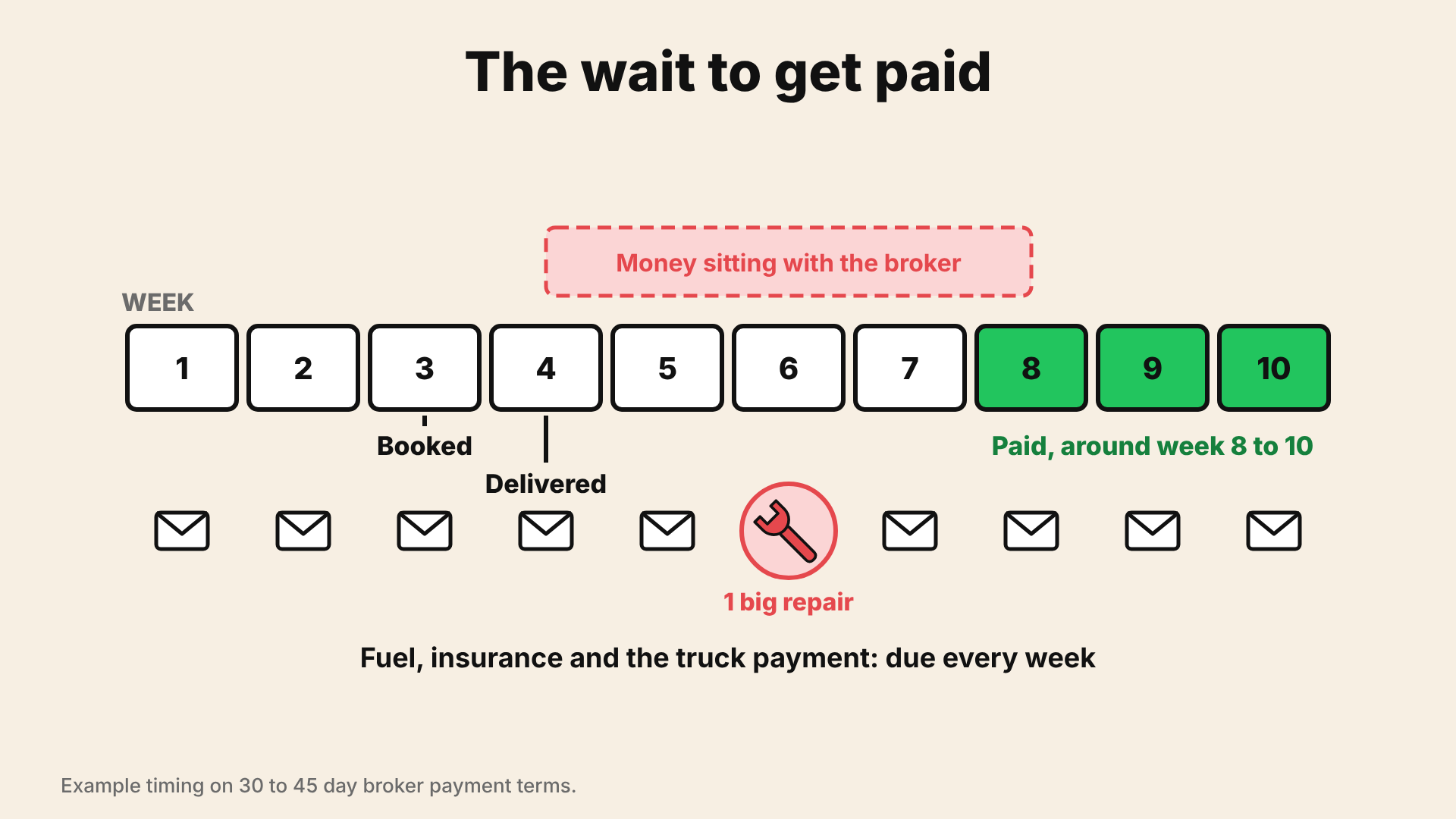
The third number is cash. Hauling a load and getting paid for it happen weeks apart. Broker payment terms of 30 to 45 days are common, and the truck’s bills keep coming the whole time.
A First-Load Timeline
Say you get your own authority. The FMCSA MC authority process comes first. The clock in this example starts after it, in the first week you can book freight under your own MC. This timing is an example built on 30 to 45 day terms:
- Week 3: you book your first load.
- Week 4: you deliver it and send the paperwork.
- Around week 8 to 10: the broker pays.
For that whole stretch, the money for your first load is sitting with the broker. Fuel, insurance and the truck payment are due the whole time. Every load you haul after the first one adds to what you are owed and to what you have spent, and none of those loads pays before the first one does.
Your own dates depend on each broker’s terms and how fast your paperwork goes in. Late or incomplete paperwork pushes the payment back further.
If you are working through these decisions, the full factoring series is available below:
What 1 Big Repair Does Inside the Gap
Then 1 big repair lands in the middle of that gap. A repair bill does not wait for the broker to pay. The shop expects payment before the truck leaves.
With no cushion, it goes on a credit card, and the interest follows you into next month. Next month brings the usual fuel, insurance and truck payment, with the card balance added on top. Plenty of operators who stayed busy all along run out of cash during this stretch.
Counting the Full Cost of Factoring
Some operators close the gap with factoring. A factoring company buys your invoice, pays you soon after you submit the paperwork, and collects from the broker on the broker’s terms. If you do, count the whole cost. The quoted rate is only the first line.
Worked example, with hypothetical fees:
- Say your factor quotes 2%, and your average load is $2,000. That is $40 a load.
- Add a $5 invoice fee. That is $45.
- Cash is tight, so every payment gets wired, at $35. Now it is $80 a load.
$80 on a $2,000 load is 4%, double the quoted rate ($40 + $5 + $35 = $80; $80 ÷ $2,000 = 4%).
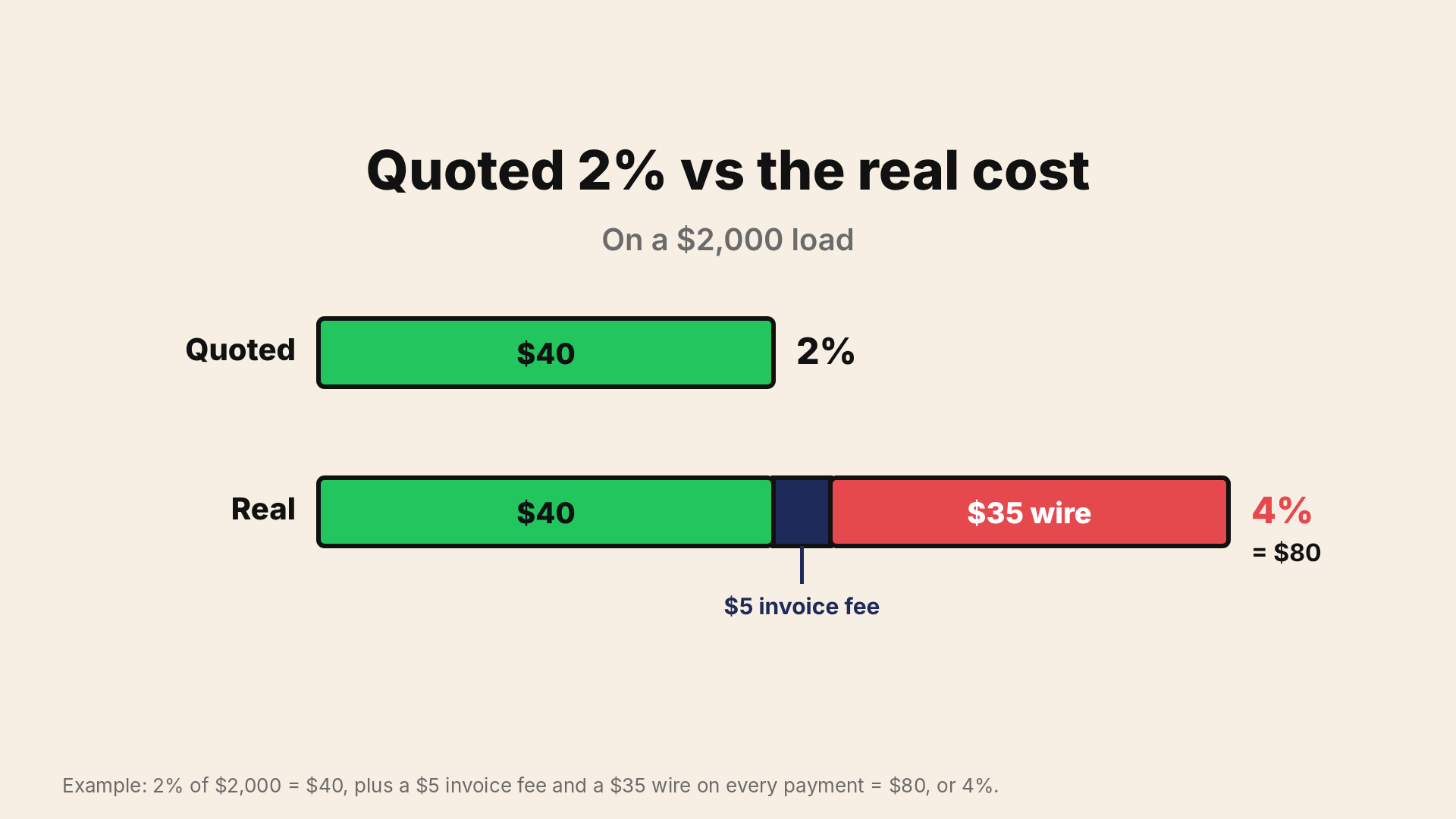
The $5 and the $35 are flat fees. They cost the same on every load, so they take a bigger share of a small one. On a $1,000 load, the same fees come to $20 + $5 + $35 = $60, which is 6%.
Those fees come out of the same gross as everything else, and they raise your floor. In the break-even example above, factoring was counted at 2%. At a real cost of 4%, the share off the top becomes 9%, and the same math gives $2.10 ÷ (0.85 × 0.91) = about $2.71 a loaded mile.
When you compare factors, ask for the full fee schedule in writing: invoice fees, wire and ACH fees, any fee on reserve releases, and monthly minimums. Go by the written agreement. I have had a factor tell me something on the phone that their written agreement contradicted.
Build the Cushion Before You Need It
Build the cushion before you need it. Keep cash for the wait, and a separate reserve for the repair.
The wait reserve covers fuel, insurance and the truck payment from your first week on the road until broker payments arrive every week on their own. In the example timeline, that means carrying the truck’s bills to around week 10.
The repair reserve is the maintenance set-aside from the first section, about 14 cents for every mile, kept in its own account. Keeping the 2 apart means a slow-paying broker cannot drain the money you were holding for tires.
The factoring series covers this and 15 other mechanisms that affect carriers in real operations:
Frequently Asked Questions
What are the biggest owner operator expenses?
Fuel is the largest cost of running the truck, and it changes every time the pump price moves. Insurance is a large fixed cost on a new authority: Overdrive puts it at $20,000 or more a year for an owner operator on a new authority with a safe record. Maintenance runs about 14 cents a mile according to ATBS, which is about $13,300 a year at 95,000 miles, and it arrives in large, uneven bills. Add the truck payment, permits and compliance filings. All of these are paid out of gross before the owner operator takes any pay, so the money in the account after a good week is the truck’s money first.
How do you calculate break-even cost per mile?
Start with cost per mile: every bill divided by every mile the truck drove, loaded and empty. Then adjust for the miles nobody pays for and the percentage fees that come off each load. The formula is cost per mile ÷ ((1 minus your empty percentage) × (1 minus your fee percentage)). In the worked example, a $2.10 cost per mile with 15% empty miles and 7% in fees gives $2.10 ÷ (0.85 × 0.93) = $2.66 per loaded mile. That $2.66 is the floor. A load that pays less than the floor costs you money on every loaded mile, even though the truck stays busy hauling it.
Why do owner operators run into cash flow problems?
Owner operator cash flow breaks down on timing. Brokers commonly pay on 30 to 45 day terms, while fuel, insurance and the truck payment are due every week or month. On a new authority, a first load booked in week 3 and delivered in week 4 may not pay until around week 8 to 10. Every load hauled in between adds to what the broker owes you and to what you have already spent. A big repair inside that gap has to be paid before the truck leaves the shop. Without a cash reserve, it goes on a credit card, and the interest carries into the next month.
How much are factoring fees in trucking?
The quoted rate is only part of the cost. In the worked example, a factor quotes 2% on a $2,000 load, which is $40. A $5 invoice fee and a $35 wire bring the total to $80 a load, a real cost of 4%, double the quoted rate. Flat fees cost the same on every load, so they take a larger share of smaller loads: the same fees on a $1,000 load come to 6%. Before signing, get the full fee schedule in writing, including invoice fees, wire and ACH fees, reserve release fees and any monthly minimums, and compare factors on the total cost per load.
Why do owner operators go broke even when the truck stays busy?
A busy truck only makes money when each load pays more than the floor. An operator who books by feel compares the offer to cost per mile, sees a $2.40 rate against a $2.10 cost and takes it. With 15% empty miles and 7% in fees, the real floor in the worked example is $2.66, so that load runs 26 cents short on every loaded mile. Each of those loads drains the account a little while the truck keeps rolling. The shortfall usually surfaces when a repair or an insurance renewal comes due and the cash is not there to pay it.
Run the 3 Numbers Before You Buy the Truck
Run these 3 numbers before you buy the truck, and again every time diesel or insurance moves.
Diesel and insurance are the 2 costs most likely to move between runs. When either one moves, recalculate cost per mile first, then the floor, then the cash you need on hand for the wait. Each number feeds the next, so the order matters.
If you are still deciding on going owner operator, run all 3 with real inputs before you sign anything: an actual truck price, an insurance quote for a new authority, and the payment terms of the brokers you expect to haul for.



Leave A Comment