
Table of Contents
There is an operator out there who runs hard all month. The truck is always moving, he is always busy, and at the end of the month there is nothing in the account. He cannot work out why. The reason is usually the same. He does not know his real cost per mile, so he keeps taking loads that lose money and calling it staying busy.
Cost per mile, or CPM, is the number that tells a good load from a bad one. It is simple arithmetic, but most operators get it wrong in two specific ways that hide a losing rate behind a full schedule. This guide walks through the full method: what CPM is, every core cost line that belongs in it, and how to turn the finished number into a break-even and a load decision. The figures are 2026 ranges that vary by operator, equipment, lanes, and credit, so treat them as the shape of the math, not your exact number.
Companion video: How to Calculate Cost Per Mile (AFT Dispatch).
What Cost Per Mile Actually Is
Cost per mile is your total cost divided by your total miles. The math is easy. Getting it honest is the part people miss, and it comes down to two mistakes.
The first mistake is the miles. Total miles means all your miles, loaded and empty, every mile the truck turns, not just the paid ones. Divide your costs only by loaded miles and you divide by a smaller number than reality, which makes your cost per mile look lower than it is. If you run 10,000 miles in a month but only 8,500 are paid, those 1,500 empty miles still burned fuel and put wear on the truck. Leaving them out of the denominator is the most common way operators fool themselves into thinking a lane works.
The second mistake is leaving costs out. Most operators count fuel and the truck payment and stop there, but the truck has a long list of bills attached, and skipping half of them produces a number that looks great on paper and empties the account in practice. So the real formula is fixed costs plus variable costs, divided by every mile you ran. The rest of this guide builds it in two pieces: the bills that hit no matter what, and the bills that climb with the miles.
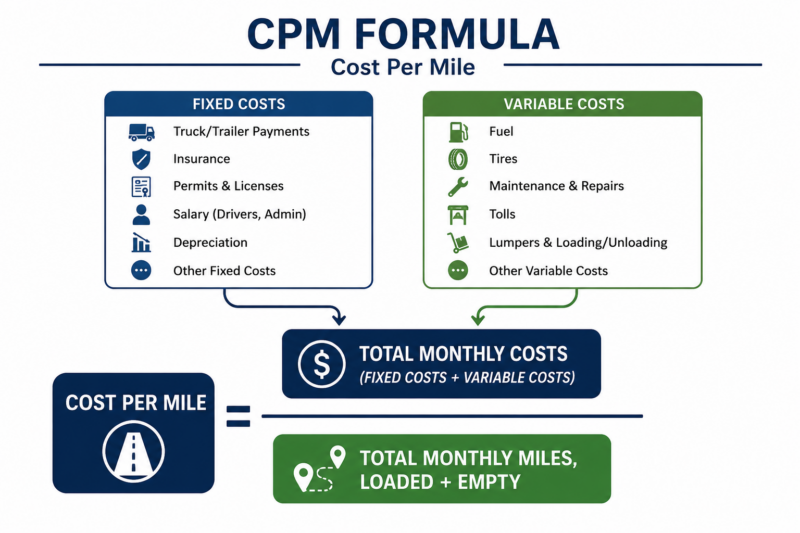
Fixed Costs: The Bills That Hit Whether You Roll or Not
Fixed costs are the bills that come whether the truck moves or not. You owe them sitting in the yard on a Sunday, which is exactly why they are dangerous to forget. A slow week does not reduce them.
The Truck Payment
The biggest fixed cost for most operators is the truck payment, and it ranges widely. A five-year-old used truck around $50,000 might run about $1,200 a month. A new sleeper runs $160,000 to $220,000, with a well-spec’d one landing around $190,000 to $200,000, which puts the payment well over $3,200 a month. That is a swing of two thousand dollars a month between two operators doing the same job.
The price is only half of it. The other half is financing. Semi loans run from about 4 percent to over 20 percent APR. Strong credit and a couple of years operating put you in the single digits. A first-time buyer or rough credit can see 15 to 35 percent and a large down payment on top. So two operators can buy the identical truck and carry completely different payments, which is why a generic CPM number from a video is close to useless. You have to run your own.
One piece operators with a paid-off truck miss: you are not done just because the note is gone. Set aside roughly $0.15 to $0.25 a mile for the replacement. The truck will wear out, and the next one is a real cost whether you have started saving for it or not.
The Trailer Is Its Own Payment
The trailer is a cost line operators routinely fold into nothing, but it is a second payment with its own bills on top. A dry van is the cheapest, around $40,000 to $50,000. A flatbed runs about $40,000 to $90,000 depending on aluminum versus steel and the spec. A reefer is the most expensive, $65,000 to $100,000 new.
The reefer does not stop at the purchase price, which is the part that catches new reefer operators. It runs its own diesel engine for the cooling unit, so you are fueling two engines, not one. It carries extra maintenance on that unit and a separate reefer-breakdown insurance policy. A flatbed has its own recurring gear too: straps, chains, binders, and tarps, all of which wear out and get replaced on a schedule. Whatever you pull, the trailer payment and its extras go into cost per mile exactly the way the truck does.
If you want this kind of line-by-line breakdown on the rest of the business, the free trucking education at AFT Dispatch goes deeper:
Insurance, Permits, and the Small Stuff
Insurance is the next fixed block. Primary liability runs roughly $8,000 to $15,000 a year, physical damage adds $3,000 to $6,000, and cargo another $1,200 to $2,400. A new authority pays more, up around $14,000 to $22,000 all in, and it drops after a couple of clean years. Blended over your miles, insurance lands around $0.10 to $0.18 a mile, and a newer truck carries higher physical-damage premiums than an older one.
Then come plates, permits, registration, IFTA, and compliance, roughly $0.02 to $0.03 a mile. Many are annual bills, so divide by twelve for the monthly piece. Finally the small stuff: ELD subscription, accounting software, a place to park. None is large on its own, but all of it belongs in the number, and leaving out the small lines is what makes a homemade CPM run light.
Variable Costs: The Bills That Climb With Every Mile
Variable costs climb with every mile you run. The more you drive, the more you spend, which makes them the part of CPM that moves week to week.
Fuel
Fuel is the big one, usually 25 to 40 percent of your whole cost per mile. Diesel in 2026 is high and moving. It has run anywhere from about $4.15 to $5.35 a gallon lately, with spikes past $6.00. At those prices and 6 to 6.5 miles per gallon, fuel lands somewhere around $0.70 to $0.90 a mile.
Here is the part to hold onto: that number moves when the pump moves. When diesel jumps thirty cents a gallon, your cost per mile jumps the same day, before you book a single load at the new reality. This is why CPM is not a figure you calculate once and tape to the wall. An operator still pricing against last month’s cheaper diesel is losing margin on every mile until he re-runs the number.
The free trucking education covers how operators actually hold their margin when costs like fuel move under them:
Maintenance and Repairs
Maintenance scales hard with the age of the truck, which is what makes it the cost line that surprises operators most. Budget $15,000 to $25,000 a year over a hundred-thousand-plus miles. A newer truck under 300,000 miles runs about $0.10 to $0.15 a mile. Past 500,000 it climbs toward $0.25, and over three-quarters of a million miles it can hit $0.35 a mile or more.
Inside that number, tires run $3,000 to $6,000 a year and brakes $1,500 to $3,000. Then the big-ticket repairs that sink unprepared carriers: an engine overhaul at $15,000 to $25,000 and a DPF replacement at $3,000 to $8,000. Most are preventable with service on time. The discipline that keeps a repair from becoming a crisis is a funded maintenance reserve, money set aside per mile every week, so the cash is there when the truck breaks instead of coming out of next week’s settlement.
The Truck-Age Trap
There is a trap in here that ties the fixed and variable sides together, and it catches operators shopping on payment alone. A used truck with a $1,200 payment looks cheaper than a new one at $3,200. But if that used truck costs $2,000 a month more in maintenance, you are paying about the same or more once everything is counted. The lesson is to compare the total cost of ownership, payment plus upkeep, not just the payment. The cheap truck is not always the cheap truck, and the operator who only looks at the note often ends up with the more expensive option.
Two smaller variable lines round it out. DEF runs about $0.01 to $0.02 a mile, roughly a gallon for every fifty gallons of diesel, and then tolls, scales, and day-to-day costs. None is large alone, but all of it goes into the number.
Turning Cost Per Mile Into a Decision
This is where the number earns its keep. A cost per mile that sits in a spreadsheet does nothing. The same number used at the moment a load comes up is what protects the business.
How Fixed Costs Spread
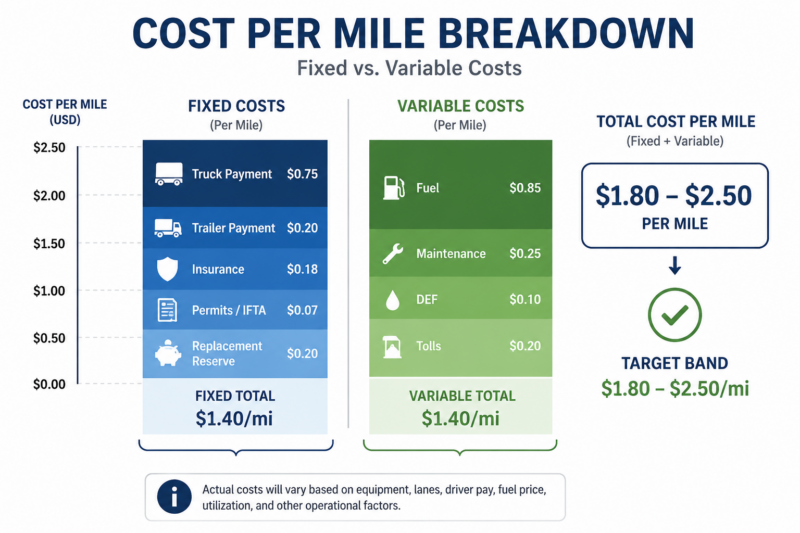
Start with how fixed costs behave across miles, because it explains why some months feel impossible. Take the same fixed bills two months running. In a month where you run only 8,500 miles, those fixed costs spread across fewer miles, so the per-mile figure is higher. In a month where you run 10,000 miles, the same bills spread thinner and the per-mile figure drops. Those are round illustrative numbers, but the lesson is real: fixed costs spread thinner the more you run, which is why a slow month hurts more than the lost revenue alone suggests. Staying moving helps, but only when the freight covers your variable cost and puts something toward the fixed side. Miles that do not clear variable cost make the problem worse, not better.
Stack the variable cost per mile on top of the fixed, and a financed operator in 2026 typically lands somewhere around $1.80 to $2.50 a mile, all in. A paid-off truck or a fuel-efficient lane can come in lower; a high-mileage truck deep into its maintenance curve or a new authority paying top-dollar insurance runs higher, past $2.50. That spread is the honest range, and your exact number depends on the line items above. The point is that the real figure for most financed operators sits well north of the dollar-and-change many drivers assume, which is why so many take freight that loses money without it being obvious.
Break-Even, Deadhead, and Saying No
Once you have the number, your break-even is total monthly expenses divided by total miles. Take freight below that line and you are paying to work. That is the entire purpose of calculating CPM: it draws the line under which a load costs you money to haul.
Deadhead is where the honesty comes in. You do not get paid for empty miles, but you always pay for them, in fuel, wear, and time. Putting deadhead into your total miles is what makes the number truthful. Count only loaded miles and you fool yourself, because your cost per mile looks lower than it really is. As a working target, keep deadhead under about 10 percent, and weigh the empty miles home into any load before you take it.
Here is the discipline the number buys you. Say your real cost is $2.10 a mile and a broker offers $2.05. If you do not know your number, you take it, because it feels like money and the truck stays busy. If you do know your number, you say no, because you can see you would lose a nickel a mile to haul it. Knowing your real cost per mile is the thing that lets you turn down freight with a straight face, and turning down the wrong freight is what keeps the right freight profitable.
One last point. Cost per mile is a working number, not a set-it-once number. When diesel moves, it moves. When a major repair hits, it moves. The operators who stay profitable run it again whenever something changes, so the figure they are pricing against is the figure they are actually paying.
If you are building your own cost-per-mile number and want the rest of the operational picture, the full library of free trucking education is below:
Frequently Asked Questions
What is a typical cost per mile for an owner-operator in 2026?
A financed owner-operator in 2026 typically lands around $1.80 to $2.50 a mile, all in, once every cost line is counted: truck and trailer payment, insurance, permits, fuel, maintenance, DEF, and tolls. A paid-off truck or a fuel-efficient lane can come in lower, while a high-mileage truck deep into its maintenance curve or a new authority paying top-dollar insurance runs higher, past $2.50. The range is wide because financing, equipment age, fuel price, and mileage all move it. The only number that matters is the one you build from your own line items, not an average from a video.
Why does my cost per mile keep changing?
Because it is a working number, not a fixed one. Fuel is the biggest mover: when diesel jumps thirty cents a gallon, your cost per mile rises the same day. Maintenance steps up as the truck ages, climbing from about $0.10 a mile on a newer truck toward $0.35 or more past three-quarters of a million miles. A major repair, a change in insurance, or a slow-mileage month that spreads fixed costs across fewer miles all shift the figure. The fix is to re-run CPM whenever a major input changes, so you are pricing against what you actually pay.
Running Your Own Number
Cost per mile is the difference between an operator who knows whether a load makes money and one who is busy and broke. The method is the same for everyone: count all the miles, count all the bills, divide one by the other, and re-run it when the inputs move. A financed operator in 2026 who counts honestly usually finds the real number lands around $1.80 to $2.50 a mile, higher than most expect. The operators who keep that number current can look at a rate and know, before the truck moves, whether the load is worth taking.





Leave A Comment