
Legal warning: This article is for general informational purposes and is not legal advice. Firearm laws vary by state, change frequently, and apply differently depending on permit status, vehicle ownership, employer policy, and the specific facts of any incident. Before carrying a firearm in a commercial motor vehicle, verify current law in every state on your route and confirm your carrier’s written policy. Penalties for getting it wrong range from termination to felony charges and loss of your CDL.
Whether a truck driver can carry a gun is one of the questions drivers most want a straight answer to, and the answers floating around are usually wrong in one of two directions. One says federal law lets you carry anywhere. The other says a gun is never allowed in a commercial truck. Both are wrong.
The accurate answer has four layers: federal law, which mostly stays out of the question; state law, which is where most truckers get arrested; carrier policy, which is where most truckers get fired; and shipper or receiver policy, which is where most truckers get banned from a facility. A driver who understands all four layers can make an informed decision. A driver who understands only the federal layer can be legally carrying in one state and committing a felony two states later on the same trip.
This guide walks through each layer, explains the federal transport protection that drivers lean on and misread, names the practical differences between company drivers and owner operators, and ends with the three checks to run before every load.
The Short Answer
 Federal law does not prohibit truck drivers from carrying firearms in commercial motor vehicles. The FMCSA has stated on the record that it has no jurisdiction over firearm possession by CMV drivers and that federal law generally does not prohibit it.
Whether you can actually carry depends on three things federal law does not control:
- State law in every state on your route
- Your carrier’s written firearm policy (most major carriers prohibit firearms outright)
- The policies of shippers and receivers you deliver to
A trucker holding a valid concealed carry permit in their home state can be legally carrying in Texas in the morning and committing a state crime in Illinois by that evening on the same run. That is the actual problem this question is asking about.
If you want operational walkthroughs of the freight side of the business, the free trucking education at AFT Dispatch goes deeper:
Layer 1: What Federal Law Actually Says
FMCSA Has No Jurisdiction
The Federal Motor Carrier Safety Administration regulates commercial vehicle safety, hours of service, CDL standards, drug and alcohol testing, and hazardous materials transport. It does not regulate firearm possession.
In its April 2020 written response to the Small Business in Transportation Coalition petition that asked the agency to preempt state firearm laws for interstate CMV drivers, the FMCSA, through Associate Administrator Larry Minor, stated: “FMCSA does not have jurisdiction over firearms possession by commercial motor vehicle (CMV) drivers engaged in interstate commerce, and the matter is outside FMCSA’s preemption authority. Our understanding is that Federal law generally does not prohibit CMV drivers from carrying firearms in their vehicles, provided that they comply with State and local laws. Such action may also be subject to restrictions imposed by employers, owners, or operators of the CMVs.”
That agency response settles the federal regulatory question. The Federal Motor Carrier Safety Regulations contain no provision addressing personal firearms in a CMV. Truckers are subject to the same federal firearm laws as any other citizen.
The Peaceable Journey Law
The Peaceable Journey Law (codified at 18 U.S.C. § 926A, see Cornell Law, law.cornell.edu/uscode/text/18/926A) was enacted as part of the Firearm Owners Protection Act of 1986. It allows a person who can legally possess a firearm in their state of origin and in their state of destination to transport that firearm through any state in between, even states that would otherwise prohibit possession.
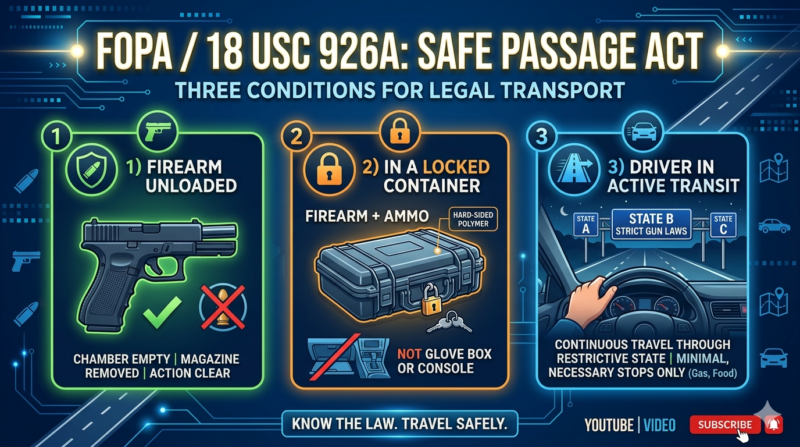
To qualify for the protection, three conditions must be met during the entire trip through the restrictive state:
- The firearm must be unloaded
- Neither the firearm nor the ammunition can be readily accessible from the passenger compartment. In a vehicle without a separate trunk (which describes every semi-truck), both must be in a locked container other than the glove compartment or console
- The driver must be in active transit; extended stops in the restrictive state break the protection
What the Peaceable Journey Law does not do:
- It does not allow concealed carry. It is a transport protection, not a carry permit.
- It does not protect a driver who lives in a restrictive state and is just driving through their own state.
- It does not prevent arrest. It is an affirmative defense, raised after charges are filed. Lawful gun owners have been arrested and prosecuted in New York and New Jersey while attempting to assert this protection.
- It does not apply to magazines, suppressors, or other accessories that the destination state may prohibit even if the firearm itself is legal.
Legal warning: This protection is not a get-out-of-jail-free card. New York and New Jersey have repeatedly arrested travelers who appeared to comply with the law. The protection is real but narrow. If a route requires significant time in a restrictive state, it may not cover the stop. When in doubt, leave the firearm at home or ship it ahead through a licensed dealer.
Layer 2: State Law, Where Most Truckers Get Arrested
State firearm law is where the trucker question gets complicated. There is no national concealed carry permit. The Constitutional Concealed Carry Reciprocity Act has been introduced in Congress multiple times, most recently as H.R. 38, and has never passed. Reciprocity is patchwork, changes by legislative session, and is the single most common reason a trucker with a valid permit ends up in handcuffs.
There are three buckets to understand.
Permissive States (Easiest for Truckers)
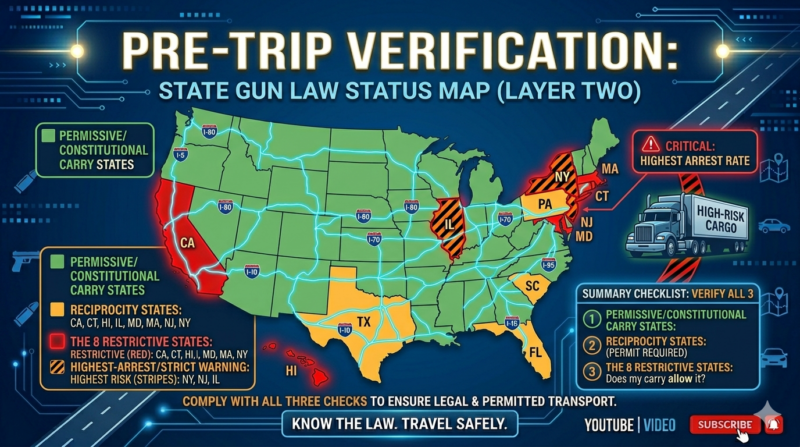
As of 2026, roughly 29 states have some form of constitutional carry, which means a legal gun owner can carry concealed without any permit. Examples include Texas, Tennessee, Florida, Georgia, Arizona, Alabama, Ohio, and Indiana. Truckers driving through these states generally face no permit issue, though carrier policy and shipper rules still apply.
Several of these states also have very broad reciprocity, honoring permits from nearly any other state. A driver with a Florida or Utah non-resident permit gets the widest practical coverage on the road. Florida and Utah permits together cover the largest number of states in the country.
Shall-Issue Reciprocity States (Manageable for Truckers)
Another group of states requires a permit but honors permits from many other states. These are the states where reciprocity research actually matters. Permit honored, legal. Permit not honored, felony. The line is binary, and this is where Florida and Utah non-resident permits earn their keep, because the combined reciprocity covers nearly every state that recognizes any outside permit at all.
 No-Reciprocity States (Where Truckers Get Arrested)
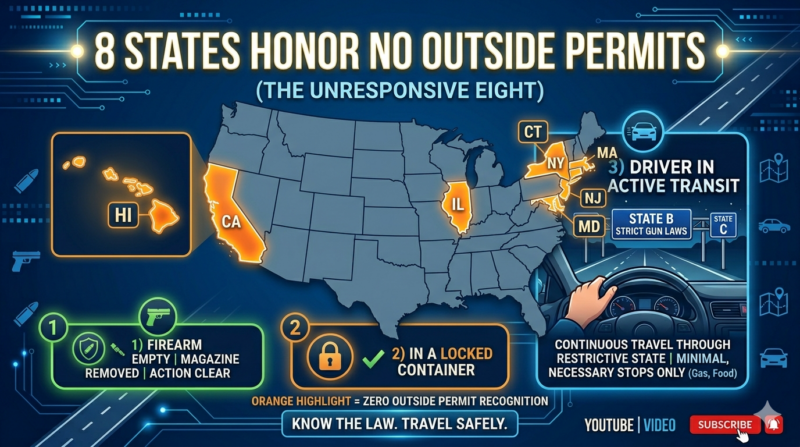
As of 2026, ten states honor no outside concealed carry permits at all: California, Connecticut, Hawaii, Illinois, Maryland, Massachusetts, New Jersey, New York, Oregon, and Rhode Island. A trucker driving through any of these states with a loaded, accessible firearm is committing a state crime regardless of any permit held in their home state.
Practical reality from carrier safety departments and CDL legal services: the highest-enforcement states for truckers carrying firearms are New York, New Jersey, and Illinois. These three states have aggressive enforcement, low tolerance for asserted-but-unproven transport defenses, and a steady stream of arrested out-of-state truckers.
Legal warning: Crossing into any of the ten no-reciprocity states with a loaded firearm, even with a valid permit from another state, is a state crime. Penalties can include felony charges, prison time, permanent loss of gun rights, and loss of your CDL. The legal cost of defending the case routinely exceeds the cost of the truck.
A driver running a New England route, a route through the Northeast Corridor, or any lane that touches Chicago or the California ports faces the highest exposure. The decision for these lanes is usually to either not carry, ship the firearm ahead through a licensed dealer, or refuse the lane.
Local Laws and Ordinances
Local laws can differ from state laws. A growing number of cities enforce ordinances that ban specific firearms or magazines beyond what the state itself restricts. Chicago is the textbook example. The city has long-standing ordinances restricting certain firearms and magazine capacities that go beyond Illinois state law. A trucker who is somehow compliant with Illinois state law but enters Chicago city limits with a prohibited firearm or magazine is in violation of the city ordinance even if the state law would have allowed it.
Other cities with stricter-than-state firearm ordinances include New York City, where the city’s licensing requirements are among the most restrictive in the country, beyond what New York State already imposes, and Washington D.C., which has its own firearm registration scheme separate from any state framework, plus a handful of California cities with additional local restrictions.
For interstate trucking, the practical rule is that city ordinances only matter when the route actually crosses through that city’s boundaries. A driver who runs around Chicago on I-294 does not enter Chicago city limits and is not subject to Chicago ordinances. A driver who drops a load at a warehouse on the South Side has entered Chicago and is subject to every city restriction. Read the actual route, not just the state.
The freight side of the business has its own layered rules, much like the legal map above. The free AFT Dispatch education breaks down how the money side actually works:
Layer 3: Carrier Policy, Where Most Truckers Get Fired
Even when state and federal law allow a trucker to carry, the carrier they drive for usually does not. Nearly every major motor carrier in the United States prohibits firearms in company-owned trucks, including:
- Swift Transportation
- Schneider National
- Werner Enterprises
- J.B. Hunt
- CRST International
- Knight Transportation
- C.R. England
- U.S. Xpress
The policy usually applies to company drivers, lease purchase drivers, independent contractors, and owner operators leased to the carrier. The rationale carriers cite is consistent: liability exposure if a firearm incident occurs while the driver is on duty, insurance underwriting concerns, shipper requirements, and risk of losing key customer accounts.
Violating a written firearm policy is grounds for immediate termination at most carriers. The termination itself is the smaller problem. The DAC report and PSP record entry that follows can make a driver effectively unhireable at other major carriers for years.
Operational reality: Some smaller and mid-size carriers are quieter on firearm policy or permit carry with prior written approval. If carrying matters to you, ask in writing during orientation, not after the fact. A verbal yes from a recruiter is worth nothing if the written policy says otherwise.
Owner Operators With Their Own Authority
This is the practical difference that matters. An owner operator running under their own MC number sets their own firearm policy on their own truck. There is no employer to fire them. There is no carrier handbook to violate.
That does not eliminate the other three layers. Federal law, state law, and shipper policy all still apply identically. But the carrier-policy layer disappears. Many drivers cite this as one of several reasons they eventually pursue their own authority. The full path to running under your own MC number is covered in our guide on how to start a trucking company, and in our guide on how to become an owner operator.
Layer 4: Shipper and Receiver Policy
The fourth layer catches even owner operators with their own authority. Most major shippers and receivers prohibit firearms on their property. Examples commonly cited by drivers and carrier safety departments:
- Amazon fulfillment centers
- Walmart distribution centers
- Most large food distribution facilities
- Government facilities and military bases
- Some major retail chain DCs
These are private property and they can set whatever rules they want on what enters the gate. Some have armed guards who check trucks at the entrance. Some post signage but rarely enforce. Some trespass any driver who is discovered carrying, without much warning. The penalty is usually a ban from the property, which can mean losing the lane entirely if the customer represents repeat freight.
If a driver carries, the firearm needs to be securely locked away before pulling into any major shipper or receiver. On your person is the wrong answer at the guard shack.
Cash flow, broker mechanics, and operational decisions all interact like the legal layers in this article. The free education unpacks the freight side:
Practical Operational Considerations
Storage in a Sleeper Cab
Semi-trucks have no separate trunk. Under the Peaceable Journey Law, that means both the firearm and ammunition must be in a locked container other than the glove compartment or console. A bolted-down gun safe under the bunk is the standard solution. Loose storage in a duffel bag does not meet the locked-container requirement and does not provide any protection during a roadside inspection.
Most truckers who carry use a small biometric or combination safe bolted to the floor or to the bunk frame. The bolt-down matters legally and practically. An unsecured safe is treated as not meeting the locked-container requirement in some states, and an unsecured safe will be stolen during the first truck break-in.
Roadside Inspections
A DOT roadside inspection at a weigh station is generally focused on logbooks, hours of service, ELD data, brakes, tires, lights, and cargo securement. Inspectors do not typically search the sleeper area without cause. They are not looking for firearms.
If asked directly whether the truck contains a firearm, lying to a DOT officer or a state trooper is a separate crime. The right answer is the truthful one. Most state law requires a CCW holder to inform law enforcement of a firearm if asked, and some states require notification even without being asked. Verify the duty-to-inform rule in each state you run through.
 Loaded, Unloaded, and Carried: Three Different Legal States
- Transport (unloaded, locked, separate ammo): covered by the Peaceable Journey Law across state lines if origin and destination both allow possession
- Possession in vehicle (loaded, accessible): governed by each state’s vehicle carry rules
- Concealed on person: governed by each state’s concealed carry law and reciprocity
A driver who is transporting under the Peaceable Journey Law is not carrying in any state. A driver who has a loaded handgun in the bunk while parked at a truck stop in Texas is concealed-carrying under Texas law, which permits it. The same driver in the same configuration parked in New Jersey is committing a state crime regardless of any out-of-state permit.
Crossing Into Canada or Mexico
This is the section most likely to ruin a career. Handguns are effectively prohibited for civilian import into both Canada and Mexico. Truckers caught crossing either border with an undeclared firearm face arrest, federal charges in both countries, vehicle seizure, and permanent loss of border-crossing privileges.
The Canada Border Services Agency has arrested commercial drivers at multiple ports of entry for undeclared firearms in their truck cabs. Mexican federal law treats handgun possession by foreign nationals as a serious felony. There is no Peaceable Journey equivalent at international borders.
Legal warning: If your route crosses into Canada or Mexico, even occasionally, do not have a firearm in the truck. There is no safe storage, no declaration form, and no I-forgot defense at a commercial port of entry. The standard practice for cross-border drivers is to leave personal firearms at home entirely, not in the truck.
Drivers who run primarily domestic lanes but occasionally take Canadian or Mexican loads need a clear rule. The risk of forgetting that a firearm is in the truck on the day a cross-border load gets dispatched is real and career-ending.
Special Situations
Truckers With Hazmat Endorsements
A hazmat endorsement requires a TSA Security Threat Assessment, which includes a federal background check. The hazmat endorsement does not change firearm carry rules, but a firearm-related arrest or conviction can result in revocation of the hazmat endorsement, which is a meaningful career consequence for drivers running tanker, chemical, or explosives freight.
Drivers With Prior Convictions
Federal law prohibits firearm possession by anyone convicted of a felony, anyone convicted of a misdemeanor crime of domestic violence, and several other categories. A driver in any prohibited category cannot legally possess a firearm anywhere in the United States, regardless of state law, the Peaceable Journey Law, or carrier policy. Under 18 U.S.C. § 922(g), the penalty for prohibited-person firearm possession is a federal felony carrying up to 15 years in prison, a maximum raised from 10 years by the Bipartisan Safer Communities Act in 2022.
Less-Lethal Alternatives
Pepper spray, expandable batons, and stun guns are alternatives some carriers permit even when firearms are prohibited. Each is regulated separately by state law, and often more strictly than drivers assume. In Massachusetts, for example, stun guns require a License to Carry and are treated as firearms. Verify the state-by-state status of any less-lethal tool before relying on it across state lines.
If you are working through these operational decisions, the full library of free trucking education is available below:
Frequently Asked Questions
Can truck drivers carry guns under federal law?
Yes. The Federal Motor Carrier Safety Administration has stated on the record that it has no jurisdiction over firearm possession by CMV drivers and that federal law generally does not prohibit truck drivers from carrying firearms in their vehicles. There is no FMCSA regulation addressing personal firearms in commercial vehicles. Truckers are subject to the same federal firearm laws as any other citizen, which means the actual question is what state law and carrier policy allow. Federal law sets a floor; states and employers set the ceiling.
Does the Peaceable Journey Law protect truck drivers crossing state lines with a firearm?
The Peaceable Journey Law, codified at 18 U.S.C. § 926A, protects interstate transport of a firearm if the driver can legally possess it in both the origin and destination states, the firearm is unloaded, both the firearm and ammunition are in a locked container not accessible from the passenger compartment, and the driver is in active transit. The law does not authorize concealed carry. It is an affirmative defense raised after arrest, not protection against arrest. Drivers have been arrested and prosecuted in New York and New Jersey despite asserting compliance.
Which states are the most dangerous for truckers carrying guns?
As of 2026, ten states honor no out-of-state concealed carry permits: California, Connecticut, Hawaii, Illinois, Maryland, Massachusetts, New Jersey, New York, Oregon, and Rhode Island. Of these, New York, New Jersey, and Illinois have the highest reported rates of out-of-state trucker arrests for firearm violations. A trucker with a valid Florida or Texas permit is committing a state crime by carrying a loaded firearm in any of these ten states. Penalties can include felony charges, prison time, and permanent loss of gun rights and CDL eligibility. Reciprocity changes by legislative session, so verify the current list before you travel.
Do major trucking companies allow firearms in company trucks?
Most do not. Swift, Schneider, Werner, J.B. Hunt, CRST, Knight, C.R. England, and U.S. Xpress all prohibit firearms in company-owned trucks. These policies typically apply to company drivers, lease purchase drivers, independent contractors, and owner operators leased to the carrier. The rationale is liability exposure, insurance underwriting, shipper requirements, and customer relationships. Violating a written firearm policy is grounds for immediate termination and a DAC report entry that can make a driver hard to rehire elsewhere. Carrier policies change, so confirm your carrier’s current written policy during orientation.
Can owner operators with their own authority carry guns in their truck?
Owner operators running under their own MC number set their own firearm policy on their own truck because there is no employer to enforce a carrier handbook against them. The other three legal layers still apply: federal law, every state’s individual law, and the firearm policies of any shipper or receiver they deliver to. Owner operators are not exempt from state restrictions, the Peaceable Journey Law’s transport requirements, or shipper bans at major distribution centers. The carrier-policy layer disappears, but the other three remain identical to what company drivers face.
Can a trucker bring a firearm into Canada or Mexico?
In almost all cases, no. Handguns are effectively prohibited for civilian import into both countries. There is no Peaceable Journey equivalent at international borders, no declaration form that resolves the issue at a commercial entry point, and no defense for an undeclared firearm in a truck cab. The Canada Border Services Agency has arrested multiple commercial drivers for undeclared firearms at ports of entry. The standard practice for drivers running cross-border lanes is to leave personal firearms at home rather than risk an accidental cross-border dispatch.
Bottom Line for Truckers
Federal law does not prohibit truckers from carrying firearms in commercial motor vehicles, and the FMCSA has confirmed this in writing. That single fact is where most of the misunderstanding starts. Federal law sets the floor. State law, carrier policy, and shipper rules set everything above it.
A trucker who wants to carry needs to verify three things before each route: that every state on the route allows the trucker’s specific permit to be honored, that the carrier’s written firearm policy allows it, and that the shippers and receivers on the load do not ban firearms on their property. If any of the three says no, carrying that day creates legal, employment, or customer exposure that usually exceeds whatever protection the firearm was meant to provide.
For owner operators running under their own authority, the carrier layer falls away. The legal layers do not. The same state-by-state map applies, and the same no-reciprocity states still arrest out-of-state truckers for the same violations. Independence from a carrier handbook is not independence from state law.
The drivers who manage this question well treat it the same way they treat hours of service or weight limits, as a route-planning input. Know which states on the route are restrictive. Know the carrier policy. Know the shipper policy. Make the decision before the load, not at the weigh station.
Please be aware. The information contained in this post does not constitute legal advice.



Leave A Comment