

Table of Contents
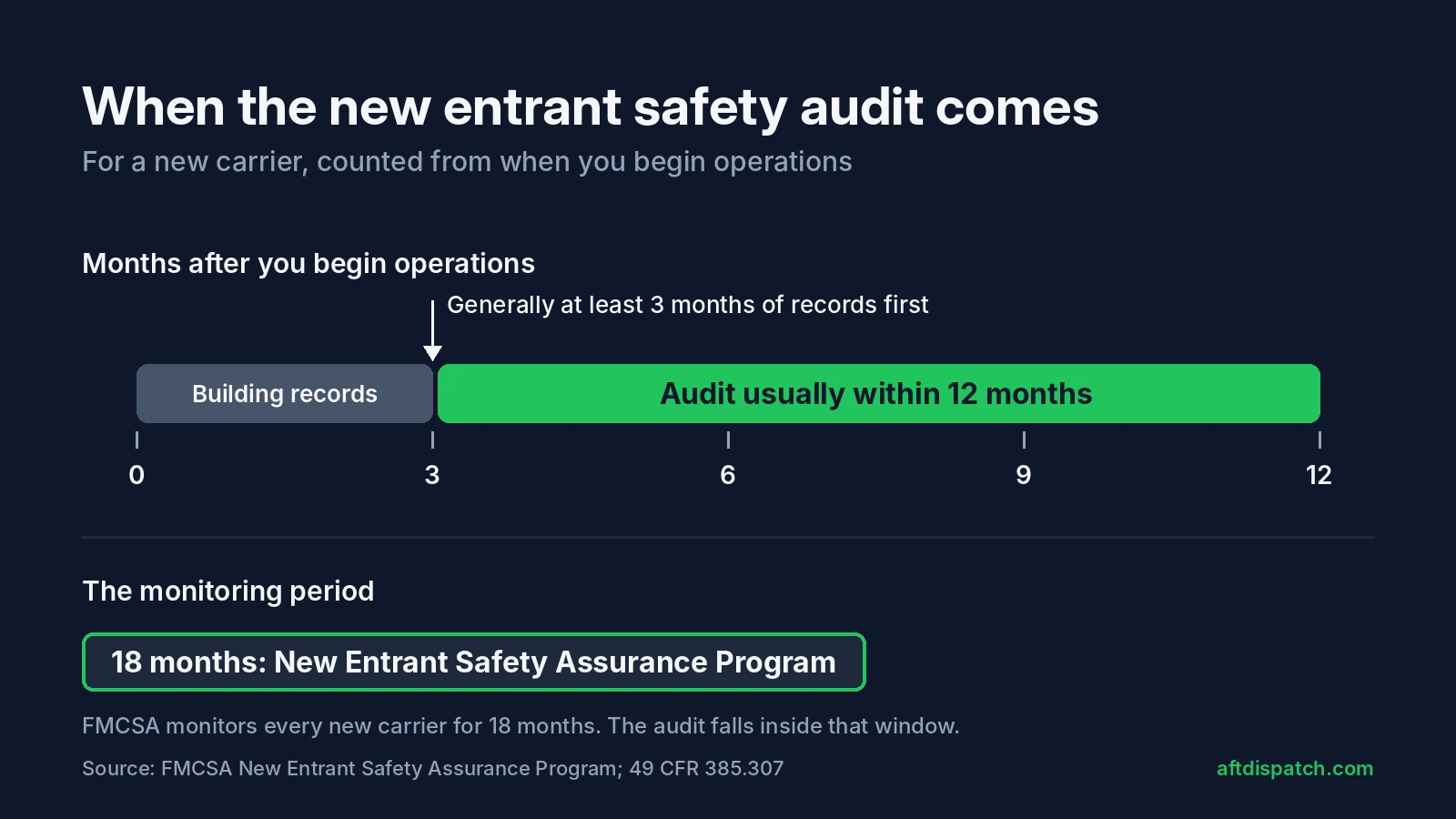
The new entrant safety audit is FMCSA’s review of a new carrier’s safety records. It usually comes within 12 months of when you begin operations, inside an 18-month monitoring period that every new carrier goes through. A few items fail the audit on their own. The rules list 16 violations that fail it automatically, and 14 of those need only 1 occurrence.
Audit checklists are usually written for fleets with a safety department. A 1-truck owner operator with his own authority is the carrier and the driver at once, so the records a fleet keeps on its drivers, you keep on yourself. This article sorts the audit that way, starting with when it comes and ending with the files the auditor opens. The video below covers a new authority’s first year, and the audit part starts at 12:02, near the end.

When the Audit Comes and Where It Happens
FMCSA monitors every new carrier for 18 months under the New Entrant Safety Assurance Program (49 CFR 385.307; FMCSA program page). The safety audit falls inside that window. According to FMCSA, it usually comes within 12 months of when the carrier begins operations (FMCSA New Entrant brochure, June 2023).
The audit doesn’t come in your first weeks. The regulation has FMCSA wait until the carrier has run long enough to have records to review, generally at least 3 months. So the audit looks at records you’ve already made, starting from your first load.
Audits usually happen at the carrier’s principal place of business. FMCSA may also hold the audit at a location you both agree on, or ask you to send documents by electronic upload, fax or email (FMCSA brochure).
What the Auditor Checks
FMCSA’s brochure lists the areas the audit covers, each tied to a part of the federal motor carrier rules:
- Accidents (Part 390): the accident register.
- Insurance (Part 387): the required minimum coverage.
- Vehicle maintenance (Parts 393 and 396): inspections, repairs and maintenance records.
- Drug and alcohol testing and driver qualification (Parts 382, 383, 391 and 392).
- Hours of service (Part 395).
- Hazmat and household goods, only if they apply to your operation.
If you haul placarded hazmat loads, extra rules apply on top of everything in this article.
The 16 Violations That Fail the Audit Automatically
49 CFR 385.321(b) lists 16 violations that fail a new entrant audit by themselves. 14 of them fail on a single occurrence. The other 2 (no records of duty status, and no periodic inspection) fail when 51% or more of the records examined are in violation.
Where the rule says “using a driver,” the driver is you if you run a 1-truck operation on your own authority. Here are the 16 in plain words, grouped by area, with the regulation for each in parentheses.
Drug and alcohol
- No alcohol and drug testing program (382.115(a) and (b)).
- Using a driver with an alcohol concentration of 0.04 or higher (382.201).
- Using a driver who refused a required test (382.211).
- Using a driver known to have tested positive for drugs (382.215).
- No random testing program (382.305).
Driver
- Knowingly using a driver without a valid CDL (383.3(a), 383.23(a)).
- Knowingly letting a driver operate with a disqualified or revoked CLP or CDL (383.37(b)).
- Knowingly letting a disqualified driver operate (383.51(a)).
Insurance
- Operating without the required minimum insurance (387.7(a)).
- The same rule for passenger vehicles (387.31(a)). It doesn’t apply to freight.
Driver qualification
- Knowingly using a disqualified driver (391.15(a)).
- Knowingly using a driver who isn’t physically qualified, meaning no valid medical certificate (391.11(b)(4)).
Hours of service
- Not requiring drivers to keep a record of duty status (395.8(a)), when 51% or more of the records examined are in violation.
Vehicles
- Operating a vehicle declared out of service before it’s repaired (396.9(c)(2)).
- Operating before fixing out-of-service defects listed on a driver vehicle inspection report (DVIR), the report a driver fills out on the truck’s condition (396.11(a)(3)).
- Using a vehicle that hasn’t had its periodic (annual) inspection (396.17(a)), when 51% or more of the records examined are in violation.
FMCSA’s brochure also lists failing to use required ELDs (electronic logging devices), or failing to require drivers to record hours of service, among the automatic failure items.
The 16 aren’t the only way to fail. Under 385.321(a), a carrier can also fail for a lack of basic safety management controls, which are spelled out in Appendix A to Part 385.
This is one piece of running a tighter operation. If getting paid is the piece you’re working through, the free 16-video factoring series covers what it actually costs:
The Audit Sorted for a 1-Truck Owner Operator
A fleet has drivers, and the auditor asks for each driver’s file, test results and logs. When you hold the authority and drive the truck, you’re that driver. Every record below is about you or your truck, and most of it belongs in place before the truck takes its first load. The compliance section of our guide to starting a trucking business covers the program in brief. This is the detailed version.
Before the First Load
- Insurance in force at the required minimum. For a for-hire carrier of nonhazardous property in a vehicle of 10,001 lbs or more, the federal minimum is $750,000 in liability (49 CFR 387.9). Operating without it is automatic failure 9.
- A spot in a consortium’s random testing pool. An owner operator who drives his own truck must be in one (FMCSA, owner-operator testing). No testing program and no random program are automatic failures 1 and 5.
- Clearinghouse registration. Employers must register in the Drug and Alcohol Clearinghouse (FMCSA brochure). An owner operator who employs himself as a driver must also designate a C/TPA (a consortium or third-party administrator) for his Clearinghouse reporting (49 CFR 382.705(b)(6)).
- An ELD in the truck, installed and logging, where your operation requires one.
Your Own Driver Qualification File
Under 49 CFR 391.51, a carrier keeps a file on each driver. Yours is a file on yourself, and it holds:
- your driver application (391.21);
- your motor vehicle record (MVR) pulled at hiring (391.23);
- a road test certificate or its equivalent (391.31 or 391.33);
- the annual MVR (391.25(a)) and the note from the annual review (391.25(c)(2));
- your medical examiner’s certificate (391.43(g));
- a note that you checked the medical examiner’s listing on the National Registry (391.23(m)).
The file is kept for as long as you drive for the company, plus 3 years. 2 of the automatic failures live in it: the medical certificate has to be current (failure 12), and the CDL has to be valid (failure 6).

Every Day on the Road
Hours of service records are the daily record the auditor samples, and failure 13 is triggered when 51% or more of the ones examined are in violation. Out-of-service defects get fixed before the truck moves. That covers a vehicle declared out of service at an inspection (failure 14) and any out-of-service defect on your own DVIR (failure 15).
Every Year
Each vehicle gets its periodic inspection, the annual inspection that failure 16 checks at the 51% mark. Your driver file gets a new MVR and the annual review note. These sit on the calendar next to the yearly filings in the 2290, IRP, and IFTA stack, so it helps to set the dates at the same time.
The Files the Auditor Opens
- The maintenance file for each vehicle you control (49 CFR 396.3). It identifies the vehicle (make, serial number, year, and who furnished it if you don’t own it), carries a schedule showing the type and due date of each inspection and maintenance task, and records every inspection, repair and maintenance job with its date. Keep it for 1 year where the vehicle is housed or maintained, and for 6 months after the vehicle leaves your control.
- The accident register (49 CFR 390.15(b)). For each accident it records the date, the city and state, the driver’s name, any injuries and fatalities, and whether hazmat was released (fuel from the truck’s own tanks doesn’t count). Copies of accident reports required by states or insurers go with it. Each entry is kept 3 years. Keep the register even if it’s empty.
- Your driver qualification file, as above.
- Your drug and alcohol testing records.
- Your hours of service records.
All of these look back. The auditor reviews the months you’ve already run, so a testing program started the week before the audit still leaves every earlier month without records. A file that starts with the first load has nothing missing when the audit comes.
Running your numbers is one side of the business. Getting paid is another. My free 16-video series breaks down what factoring really costs:
What Happens If You Fail the Audit
A failed audit starts a clock. A property carrier has 60 days from the notice to fix the problems and show FMCSA it has (49 CFR 385.319(c); FMCSA brochure). Passenger carriers and placarded hazmat carriers have 45 days.
If the carrier doesn’t, FMCSA revokes its new entrant registration and issues an out-of-service order (49 CFR 385.325). It takes effect on day 61 from the notice, or day 46 for the 45-day cases, unless an extension applies.
Frequently Asked Questions
How long after getting authority is the new entrant safety audit?
FMCSA says the safety audit usually comes within 12 months of when a carrier begins operations. It sits inside the 18-month New Entrant Safety Assurance Program, which is the period FMCSA monitors every new carrier. The regulation also has FMCSA wait until the carrier has operated long enough to have records to review, generally at least 3 months. So the audit won’t come in your first weeks, but it can come any time after that inside the first year. Plan as if every record from your first load on will be reviewed, because the audit looks back over the months you’ve already run.
Can the new entrant safety audit be done remotely?
It can, if FMCSA chooses. FMCSA’s new entrant brochure says audits usually happen at the carrier’s principal place of business. FMCSA may also hold the audit at a location you both agree on, or ask you to send the documents by electronic upload, fax or email. Whichever format FMCSA uses, the areas the audit covers stay the same: accidents, insurance, vehicle maintenance, drug and alcohol testing, driver qualification and hours of service. For a 1-truck owner operator, that means your own driver file, testing records, logs, maintenance file, accident register and proof of insurance, ready to hand over or send.
What documents does the auditor ask for?
The audit covers accidents, insurance, vehicle maintenance, drug and alcohol testing, driver qualification and hours of service, plus hazmat and household goods if they apply. For a 1-truck owner operator, that means your accident register (even if it’s empty), proof of insurance at the required minimum, the maintenance file for each vehicle you control, your consortium and testing records, your Clearinghouse registration, your own driver qualification file and your hours of service records. The driver file holds your application, MVRs, road test certificate or equivalent, medical examiner’s certificate, annual review note and the National Registry check note.
Does an owner operator need drug and alcohol testing?
Yes. FMCSA says an owner operator who drives his own truck must be in a consortium’s random testing pool. Having no alcohol and drug testing program, or no random testing program, are both on the list of 16 violations that fail a new entrant audit automatically. Employers must also register in the Drug and Alcohol Clearinghouse. An owner operator who employs himself as a driver must designate a C/TPA (a consortium or third-party administrator) for his Clearinghouse reporting under 49 CFR 382.705(b)(6). Set all of this up before the first load, since the audit looks back at the months you’ve already run.
What happens if you fail the safety audit?
A property carrier that fails has 60 days from the notice to fix the problems and show FMCSA it has. Passenger carriers and placarded hazmat carriers have 45 days. If the carrier doesn’t, FMCSA revokes its new entrant registration and issues an out-of-service order. The order takes effect on day 61 from the notice, or day 46 for the 45-day cases, unless an extension applies. An audit can be failed by any 1 of the 16 automatic violations, or by a lack of basic safety management controls under Appendix A to Part 385.
Separate from this, if you factor your invoices or you’re about to, my free 16-video series walks through the real costs and the traps:
Putting It Together
The new entrant audit reviews records that build up from your first load: hours of service every day, a periodic inspection every year, and a driver file, testing program and maintenance file that exist before the truck moves. For a 1-truck owner operator, each of those records is about you and your truck. Set them up before the first load, keep them current, and the audit is a review of files you already keep. For the wider first-year picture, including the 3 paths into the business, see going owner operator.




Leave A Comment